BaristaFIRE and the ACA Subsidy Cliff 2026
BaristaFIRE — semi-retirement funded by part-time work plus portfolio withdrawals — is having a moment. The appeal is obvious: work 20 hours a week at something you enjoy, cover your day-to-day expenses, and let your portfolio compound untouched.
But the most common reason people choose BaristaFIRE in 2026 isn't lifestyle. It's healthcare.
The logic goes: get a part-time job at Starbucks, Costco, or UPS, qualify for employer-sponsored health insurance, and avoid buying individual coverage. Problem solved.
Except in 2026, this calculation is more complicated than it looks — and for many people, the "healthcare job" strategy actually costs more than buying ACA coverage directly.
The ACA Cliff Is Back. That Changes the Math.
Run your own numbers — FREE
10,000 Monte Carlo simulations. Forward-looking forecasts from BlackRock, JPMorgan, Vanguard, GMO, Schwab, Invesco. No account needed.
Try QuantCalc Free →In 2025, enhanced ACA subsidies made marketplace insurance cheap for almost everyone regardless of income. Those enhancements expired. In 2026, the subsidy cliff is back: earn more than 400% of the federal poverty level ($62,600 single, $84,640 for a couple), and you get zero premium tax credit.
Not reduced. Zero.
For a 55-year-old couple, that means premiums jump from roughly $400/month with subsidies to $2,200/month without them. That is a $21,600 annual swing on a single dollar of income.
This is where BaristaFIRE gets tricky.
Run your own numbers in the free calculator →
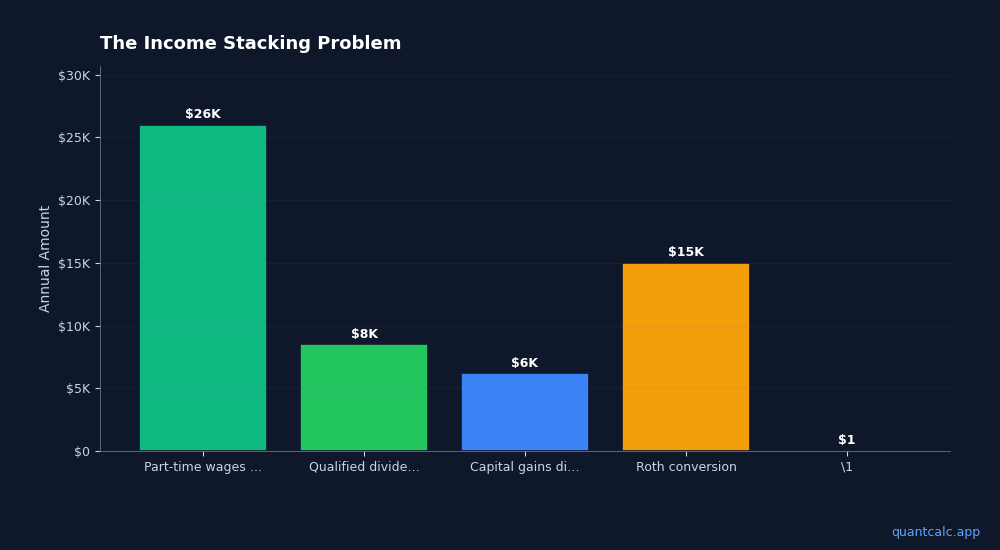
The Income Stacking Problem
Your ACA subsidy eligibility is based on Modified Adjusted Gross Income — MAGI. And MAGI includes everything:
- Part-time wages from your barista job
- Capital gains distributions from index funds (even if reinvested)
- Dividends from your taxable brokerage
- Roth conversion income if you're building a Roth ladder
- Interest income from bonds, CDs, or high-yield savings
A BaristaFIRE plan might look like this:
| Income Source | Annual Amount |
|---|---|
| Part-time wages (25 hrs/week) | $26,000 |
| Qualified dividends | $8,500 |
| Capital gains distributions | $6,200 |
| Roth conversion | $15,000 |
| Total MAGI | $55,700 |
At $55,700, a single filer is safely under the $62,600 cliff and keeps full ACA subsidies — maybe $800/month in premium support for a 55-year-old.
But what if your employer gives you a raise, or your fund kicks out an unexpected capital gains distribution in December? Push that MAGI to $63,000 and you lose the entire subsidy. Retroactively. For the whole year.
That is not a hypothetical. CNBC reported in January that the returning cliff "may mean astronomical tax bills" for people who misjudge their income by even a small amount.
When the Employer Plan Is Actually Worse
Here's what most BaristaFIRE discussions miss: employer health insurance isn't free. Part-time employee plans often have:
- Higher employee premium contributions than full-time plans
- Limited plan choices (often one option)
- Higher deductibles ($3,000-$6,000 is common for part-time eligible plans)
- No premium tax credits to offset costs
Compare that to a BaristaFIRE retiree who manages their MAGI to stay under 400% FPL. (The free ACA cliff calculator walks through exactly how to model that MAGI ceiling against part-time wages, dividends, and Roth conversions in the same tax year.)
Scenario A — Employer plan (BaristaFIRE at Costco):
- Part-time wages: $28,000
- Employee premium share: $3,600/year ($300/month)
- Deductible: $4,000
- You also lose time and flexibility working someone else's schedule
Scenario B — ACA marketplace, no employer plan:
- Part-time freelance income: $18,000
- Portfolio withdrawals: $30,000 (structured as Roth + return of basis)
- MAGI: $18,000 + $8,000 dividends = $26,000
- ACA Silver plan premium after subsidy: $1,200/year ($100/month)
- Deductible: $1,500 (Cost Sharing Reductions apply below 250% FPL)
Scenario B costs less, has better coverage, and gives you full control over your schedule. The tradeoff: you need to actively manage your income. That means knowing exactly how much MAGI each withdrawal generates, and having a tool that models the cliff in real time.
The Roth Conversion Collision
The most dangerous interaction for BaristaFIRE planners is the Roth conversion. If you're working part-time AND doing Roth conversions to build a tax-free bucket for later, both income sources stack into MAGI.
Part-time wages of $26,000 + a $40,000 Roth conversion = $66,000 MAGI. You just blew past the cliff. Your $9,600 subsidy is gone. The Roth conversion that was supposed to save you money in the long run just cost you $9,600 this year.
The fix isn't to skip Roth conversions — it's to size them precisely. Convert exactly enough to fill the gap between your other income and the cliff threshold, minus a safety margin.
For 2026, single filer: $62,600 cliff minus wages minus dividends minus cap gains = your maximum safe Roth conversion.
This is a calculation you need to run every year, with your actual numbers, accounting for all income sources. Our ACA Cliff Calculator was built for exactly this scenario — it models the subsidy cliff against your full income picture, including Roth conversions, and shows you the breakpoints.
Three Rules for BaristaFIRE Healthcare in 2026
1. Know your cliff number. For 2026, the 400% FPL thresholds are $62,600 (single), $84,640 (couple), $106,680 (family of 3), $128,720 (family of 4). Memorize yours. Build a $5,000 buffer below it.
2. Choose your health insurance BEFORE choosing your job. If staying under the ACA cliff saves you $15,000/year in premiums, that changes which jobs make sense and how many hours to work. A $15/hour barista job that pushes you over the cliff has a real cost of negative $3/hour after lost subsidies.
3. Model the full year, not just the paycheck. Your December capital gains distribution and your January Roth conversion both land in the same tax year. Use a tool that accounts for all income sources — wages, dividends, capital gains, conversions — and shows the cliff impact of each one. QuantCalc's ACA calculator does this in under two minutes.
The Bottom Line
BaristaFIRE is a legitimate strategy. But treating it as a simple "get a job with benefits" decision ignores the 2026 ACA cliff reality. For many early retirees, managing MAGI below 400% FPL and buying ACA coverage directly is cheaper, more flexible, and provides better coverage than a part-time employer plan.
The key is running the numbers — with all income sources, including the ones you don't think about — before committing to a plan. The subsidy cliff makes this a $10,000+ decision. Treat it like one.
Related reading:
- The $380,000 Healthcare Problem Nobody Talks About — full cost analysis for pre-Medicare retirees
- 0% Capital Gains: The Tax Rate FIRE Planners Forget — how to harvest gains without tripping the cliff
- 5 April 15 Tax Moves Every Early Retiree Must Make — deadline-sensitive actions before the 15th
Further Reading
Frequently Asked Questions
What is Barista FIRE?
Barista FIRE means semi-retiring with part-time work to cover health insurance and basic expenses while letting your portfolio grow untouched.
How does Barista FIRE affect ACA subsidies?
Part-time income counts toward MAGI. You can strategically earn just under 400% FPL to maximize ACA subsidies while still working part-time.
How much do you need saved for Barista FIRE?
Roughly 50-70% of your full FIRE number, since part-time income covers health insurance and reduces portfolio withdrawals.
Frequently Asked Questions
Barista FIRE means semi-retiring with part-time work to cover health insurance and basic expenses while letting your portfolio grow untouched.
Part-time income counts toward MAGI. You can strategically earn just under 400% FPL to maximize ACA subsidies while still working part-time.
Roughly 50-70% of your full FIRE number, since part-time income covers health insurance and reduces portfolio withdrawals.