ACA Cliff & Medicare Bridge Calculator: 2026 Free Tool
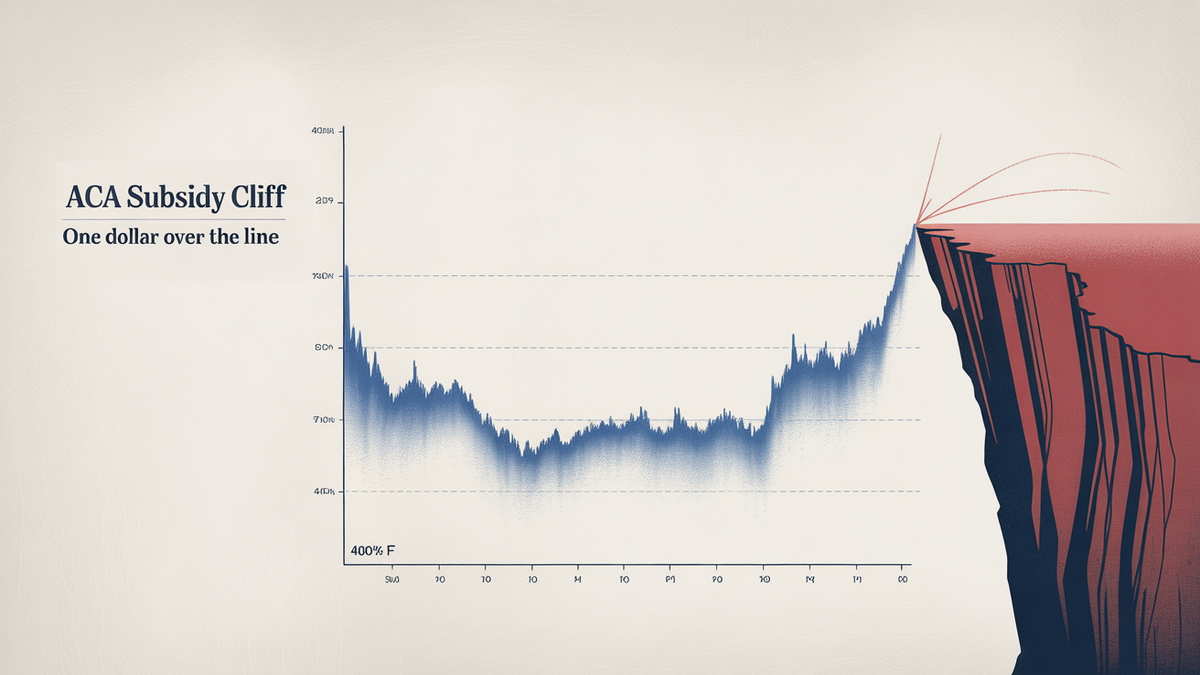
If you are bridging the gap between early retirement and Medicare at 65, the 400% FPL cliff is the single largest tax-and-subsidy trap between you and Medicare enrollment.
If you're retiring before 65, healthcare is your biggest wildcard expense. And the single most expensive mistake you can make is accidentally going $1 over the ACA subsidy cliff.
The enhanced Premium Tax Credits expired at the end of 2025. The 400% Federal Poverty Level cliff is back. For a single filer in 2026, that means earning $62,601 instead of $62,600 can cost you $10,000 or more in lost healthcare subsidies — overnight.
We built a free ACA subsidy cliff calculator specifically for this problem. You can run it right here, right now, with no signup.
Try it with your own numbers (2026)
Everything runs in your browser. No signup, no data sent anywhere.
Need Roth conversion modeling, IRMAA, and 10,000 Monte Carlo sims? Open the full tax-aware planner →
What the Calculator Does

Run your own numbers — FREE
10,000 Monte Carlo simulations. Forward-looking forecasts from BlackRock, JPMorgan, Vanguard, GMO, Schwab, Invesco. No account needed.
Try QuantCalc Free →The tool models your Modified Adjusted Gross Income (MAGI) against the 2026 Federal Poverty Level thresholds and shows you:
- Your distance from the cliff — exactly how much income room you have before losing subsidies
- Subsidy amount at risk — the dollar value of Premium Tax Credits you'd lose by crossing the threshold
- Roth conversion headroom — the maximum Roth conversion amount that keeps you under the cliff
- Capital gains impact — how harvesting gains or selling positions affects your subsidy eligibility
- IRMAA bracket exposure — whether your income triggers Medicare Part B/D surcharges (for those 63+ approaching Medicare)
Run your own numbers in the free calculator →
The 2026 Thresholds
The 400% FPL numbers for 2026:
| Household Size | 400% FPL (Cliff) |
|---|---|
| Single | $62,600 |
| Couple (no dependents) | $84,600 |
| Family of 3 | $106,600 |
| Family of 4 | $128,600 |
Go $1 over these numbers and you lose ALL premium subsidies — not just a portion. This is a cliff, not a slope.
What a Success-Rate Answer Leaves Out
A success-rate answer gives you the probability of not running out of money. That's necessary but insufficient. It does not tell you that:
- A $5,000 Roth conversion in year 3 of early retirement could cost you $15,000 in lost ACA subsidies
- The capital gains you harvest in December change your MAGI, which changes your subsidy, which changes your effective tax rate by 20-30 percentage points
- Your IRMAA brackets are determined by income from two years prior — so a decision in 2026 affects your Medicare premiums in 2028
The interaction between these systems is what makes early retirement tax planning genuinely difficult. It's not one calculation — it's a multi-variable optimization problem where every income decision has cascading consequences.
Who This Is For
The ACA cliff calculator is most valuable if you:
- Retire between 50-64 and need marketplace health insurance before Medicare eligibility
- Have significant pre-tax retirement accounts (traditional IRA, 401k) and are planning Roth conversion ladders
- Own taxable investment accounts where capital gains distributions or harvesting affect your MAGI
- Live on a combination of income sources (part-time work, rental income, dividends, Social Security) that collectively determine your subsidy eligibility
If your income is well below or well above the cliff, the calculator is less critical. It's designed for people in the danger zone — within $20,000 of the threshold in either direction.
How to Use It
- Go to quantcalc.app/aca
- Enter your filing status, household size, and state
- Input your expected income sources for 2026 (Social Security, pensions, withdrawals, capital gains, part-time work)
- The calculator shows your MAGI, distance from the cliff, estimated subsidy amount, and the maximum additional income you can take before losing subsidies
No account required. No email required. The calculation runs entirely in your browser — your financial data never leaves your device.
Pair It With Monte Carlo Simulation
The ACA calculator answers: "Am I safe from the cliff this year?"
For the bigger question — "Will my money last 30 years given taxes, inflation, and market volatility?" — run a Monte Carlo retirement simulation alongside it. The free tier runs 100 simulations using forward-looking forecast data from CME, BlackRock, JPMorgan, Vanguard, GMO, Schwab, and Invesco.
Together, the two tools cover both sides of early retirement planning: portfolio survival probability and annual tax optimization.
The Math That Matters
Here's a concrete example. Single filer, age 58, $1.2M in traditional IRA, $300K in Roth, $200K in taxable accounts. Plans to retire and buy marketplace insurance.
- Without optimization: Withdraws $65,000 from traditional IRA. MAGI = $65,000. Over the cliff. Loses ~$12,000 in annual subsidies. Effective healthcare cost: $18,000/year.
- With optimization: Withdraws $45,000 from traditional IRA + $17,000 from Roth (tax-free, doesn't count toward MAGI). MAGI = $48,000. Under the cliff. Keeps $12,000 subsidy. Effective healthcare cost: $6,000/year.
Same total income. Same lifestyle. $12,000/year difference in healthcare costs. Over a 7-year early retirement bridge to Medicare, that's $84,000.
This is the kind of optimization the ACA calculator helps you model. If Roth conversions are part of your plan, see how to size a Roth conversion under the 2026 ACA cliff.
The ACA subsidy cliff calculator is free and requires no account. Your data stays in your browser. Built by the team behind QuantCalc, the Monte Carlo retirement planner used by FIRE community members and financial advisors.
Further Reading
Frequently Asked Questions
How do I calculate my ACA subsidy for 2026?
Your ACA premium tax credit is based on your MAGI (Modified Adjusted Gross Income) relative to the Federal Poverty Level for your household size. Enter your income sources (wages, investment income, Social Security, Roth conversions, capital gains) into an ACA subsidy calculator to see your expected credit, proximity to the 400% FPL cliff, and how changes like IRA contributions or capital gains timing affect your subsidy.
What counts as MAGI for ACA subsidy purposes?
MAGI for ACA includes: adjusted gross income (AGI) plus tax-exempt interest, non-taxable Social Security benefits, and excluded foreign income. Key items that increase MAGI: capital gains, Roth conversions, traditional IRA/401(k) distributions, rental income, freelance income. Key items that reduce MAGI: traditional IRA contributions, HSA contributions, self-employment tax deduction, student loan interest.
Frequently Asked Questions
Your ACA premium tax credit is based on your MAGI (Modified Adjusted Gross Income) relative to the Federal Poverty Level for your household size. Enter your income sources (wages, investment income, Social Security, Roth conversions, capital gains) into an ACA subsidy calculator to see your expected credit, proximity to the 400% FPL cliff, and how changes like IRA contributions or capital gains timing affect your subsidy.
MAGI for ACA includes: adjusted gross income (AGI) plus tax-exempt interest, non-taxable Social Security benefits, and excluded foreign income. Key items that increase MAGI: capital gains, Roth conversions, traditional IRA/401(k) distributions, rental income, freelance income. Key items that reduce MAGI: traditional IRA contributions, HSA contributions, self-employment tax deduction, student loan interest.