ACA Subsidy Clawback 2026: How Much Will You Owe Back at Tax Time?
If you received advance premium tax credits through the ACA marketplace in 2025, tax time brings a reckoning. Form 8962 compares what you received to what you actually qualified for. If your income came in higher than you estimated, the IRS wants money back.
For early retirees managing multiple income streams, the clawback can be the single largest surprise on your tax return.
How the Clawback Works

Run your own numbers — FREE
10,000 Monte Carlo simulations. Forward-looking forecasts from BlackRock, JPMorgan, Vanguard, GMO, Schwab, Invesco. No account needed.
Try QuantCalc Free →When you enrolled in marketplace coverage, you estimated your Modified Adjusted Gross Income (MAGI). The government paid advance premium tax credits (APTC) directly to your insurer each month based on that estimate.
At filing time, you reconcile on Form 8962. Your actual MAGI determines your actual credit. If the advance payments exceeded your actual credit, you repay the difference.
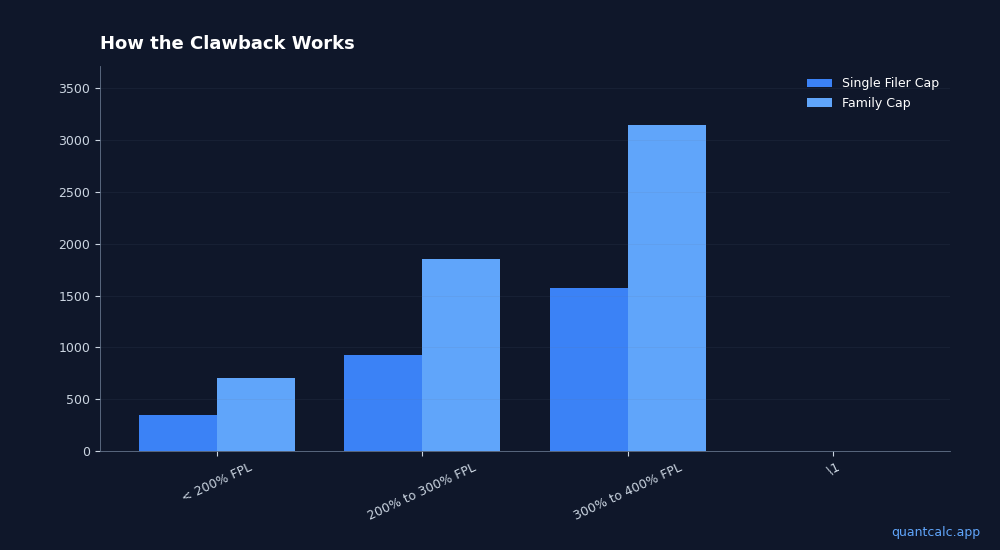
For 2025 coverage, the amount you repay is capped by where your household income landed (Rev. Proc. 2024-40 §3.07; the single column applies to unmarried filers other than heads of household, the family column to everyone else):
| Income Level (% of FPL) | Single Filer Cap | Family Cap |
|---|---|---|
| Under 200% FPL | $375 | $750 |
| 200% to 300% FPL | $975 | $1,950 |
| 300% to 400% FPL | $1,625 | $3,250 |
| Above 400% FPL | No cap | No cap |
That last row is where early retirees get hurt. For 2025 coverage the enhanced credits still applied above 400% FPL (your benchmark premium was capped at 8.5% of income under the temporary 2021-2025 rule in §36B), so crossing the line did not erase your credit. It erased the cap: you repay the full difference between the advance credit and the smaller credit you actually qualify for, however large. From 2026 coverage it gets harsher: the 400% FPL cliff is back, so crossing it means repaying every cent of advance credit, and the caps below 400% are gone too (OBBBA §71305, noted in Rev. Proc. 2025-32).
Run your own numbers in the free calculator →
Why FIRE Retirees Are Most Vulnerable
The 400% FPL line catches people whose income is variable and comes from multiple sources. That describes nearly every early retiree.
Roth conversions push MAGI up. A $40,000 Roth conversion adds $40,000 to your MAGI. If you did not factor this into your marketplace income estimate, you may have blown through the 400% FPL line without realizing it.
Capital gains are unpredictable. Rebalancing a taxable brokerage account or selling concentrated stock creates capital gains. One large sale can push your total income past the line.
Social Security taxation compounds the problem. For the premium tax credit, all of your Social Security counts toward MAGI, including the part that is not taxable. Combined with other income, this creates a feedback loop that makes the line harder to stay under.
Side income accumulates. Consulting, freelancing, rental income, or part-time work that materialized after enrollment all count toward MAGI.
For a household of two on 2025 coverage, 400% FPL is $81,760 (four times the 2024 HHS poverty guideline of $20,440). The margin between comfortable early retirement income and an uncapped repayment can be surprisingly thin. Use the free ACA cliff calculator to test your exact MAGI against the threshold before tax time.
The Real Cost: It Is Not Just the Repayment
The clawback itself is painful enough. But the second-order effects compound the damage:
Tax bracket impact. The additional income that pushed you over 400% FPL also affects your marginal tax rate. You may owe more regular income tax on the same income that triggered the clawback.
IRMAA surcharges. If you are 63 or older and approaching Medicare, higher MAGI in 2025 can trigger Income-Related Monthly Adjustment Amount (IRMAA) surcharges on your Medicare Part B and Part D premiums two years later.
Lost Roth conversion opportunity. Every dollar of ACA repayment is a dollar you cannot use for future Roth conversions, compounding the long-term tax cost.
Three Strategies to Minimize the Clawback
1. Run the Numbers Before You File
If you have not filed your 2025 return yet, calculate your actual MAGI first. Include all sources: wages, self-employment income, capital gains, Roth conversions, Social Security (all of it, including the untaxed part), rental income, and interest.
Check your Form 1095-A from the marketplace. Column B shows the monthly APTC paid on your behalf. Sum that column for your maximum repayment exposure.
If you are close to the 400% FPL line, consider whether any deductions (HSA contributions, traditional IRA contributions, student loan interest) can bring you back below 400% FPL, where the repayment cap applies again.
2. File an Extension to Buy Time
Filing Form 4868 gives you until October 15 to file. This buys time to work with a tax professional if the repayment is large or your situation is complex.
Important: an extension delays the paperwork, not the payment. If you owe tax (including the clawback), interest accrues from April 15. But it avoids the 5% per month failure-to-file penalty, which is far more expensive than the interest.
For guidance on filing extensions and the associated traps, see our guide to filing a tax extension in 2026.
3. Plan 2026 Enrollment with MAGI Modeling
The clawback is a retrospective problem. The real fix is prospective: model your MAGI before open enrollment for 2026 coverage.
This means coordinating Roth conversions, capital gains harvesting, and withdrawal sequencing around the 400% FPL threshold. The goal is to maximize your total income while keeping MAGI below the cliff, or to deliberately exceed it if your total financial picture makes the subsidy less valuable than the income.
Our ACA Cliff Calculator models exactly this interaction. It shows you where the 400% FPL line falls for your household, how Roth conversions and capital gains affect your MAGI, and the dollar impact of crossing the cliff. Free to use, no signup required.
What If You Already Filed and Got Hit?
If you already filed and the clawback appeared on your return, check whether you missed any above-the-line deductions that could reduce your MAGI. If so, you can file an amended return (Form 1040-X).
If the repayment is correct but unaffordable, the IRS offers installment agreements for taxpayers who cannot pay in full. Interest accrues, but you avoid collection actions.
The Bottom Line
The ACA subsidy clawback is not a penalty. It is the return of advance credits you received based on an income estimate that turned out to be wrong. But for early retirees managing Roth conversions, capital gains, and variable income, the mechanics of the 400% FPL line make it one of the most consequential tax events of the year.
The window to act closes on April 15.
Know your MAGI. Model your income sources. Reconcile on Form 8962 before you file. And for 2026, start planning your ACA enrollment strategy now, not in November.
Related reading: