How to Calculate Self-Employment Tax in 2026 (Step-by-Step)
Self-employment tax catches new freelancers off guard every year. If you're used to W-2 employment, you've never seen it — your employer paid half, and the other half was withheld automatically. When you go independent, the full 15.3% hits you directly.
Here's exactly how to calculate it for 2026, with worked examples at three income levels.
What Is Self-Employment Tax?

Run your own numbers — FREE
10,000 Monte Carlo simulations. Forward-looking forecasts from BlackRock, JPMorgan, Vanguard, GMO, Schwab, Invesco. No account needed.
Try QuantCalc Free →Self-employment tax is your contribution to Social Security and Medicare. W-2 employees split this cost 50/50 with their employer. Self-employed individuals pay both halves:
- Social Security: 12.4% on the first $184,500 of net earnings (2026 wage base)
- Medicare: 2.9% on all net earnings (no cap)
- Additional Medicare: 0.9% on earnings above $200,000 (single) or $250,000 (married filing jointly)
Total SE tax rate: 15.3% up to the $184,500 wage base, then 2.9% (Medicare only) above it, plus the 0.9% Additional Medicare tax once earnings pass $200,000 single / $250,000 joint.
Run your own numbers in the free calculator →
Step 1: Calculate Net Self-Employment Income
Start with your gross 1099 income and subtract business expenses.
Example: You earned $95,000 in freelance revenue and had $15,000 in business expenses (software, home office, equipment, professional development).
Net self-employment income: $95,000 - $15,000 = $80,000
Step 2: Apply the 92.35% Factor
The IRS doesn't charge SE tax on 100% of your net income. You multiply by 92.35% first. This adjustment accounts for the "employer half" deduction that W-2 workers get automatically.
SE tax base: $80,000 x 0.9235 = $73,880
Step 3: Calculate the Tax
Apply the 15.3% rate to the SE tax base:
$73,880 x 0.153 = $11,303.64
That's your annual self-employment tax. On top of whatever federal and state income tax you owe.
Step 4: Calculate Your Quarterly Payment
The IRS expects quarterly estimated payments. Divide by four:
$11,303.64 / 4 = $2,825.91 per quarter
But SE tax is only part of your quarterly payment. You also need to estimate your federal income tax. For this example ($80,000 net, single filer taking the $16,100 standard deduction for 2026, before any QBI deduction):
- Taxable income after SE deduction and standard deduction: $80,000 − $5,652 − $16,100 = $58,248
- Federal income tax: ~$7,527
- Quarterly income tax: ~$1,882
Total quarterly estimated payment: ~$4,708 ($2,826 SE + $1,882 income tax)
2026 quarterly due dates:
- Q1: April 15, 2026
- Q2: June 15, 2026
- Q3: September 15, 2026
- Q4: January 15, 2027
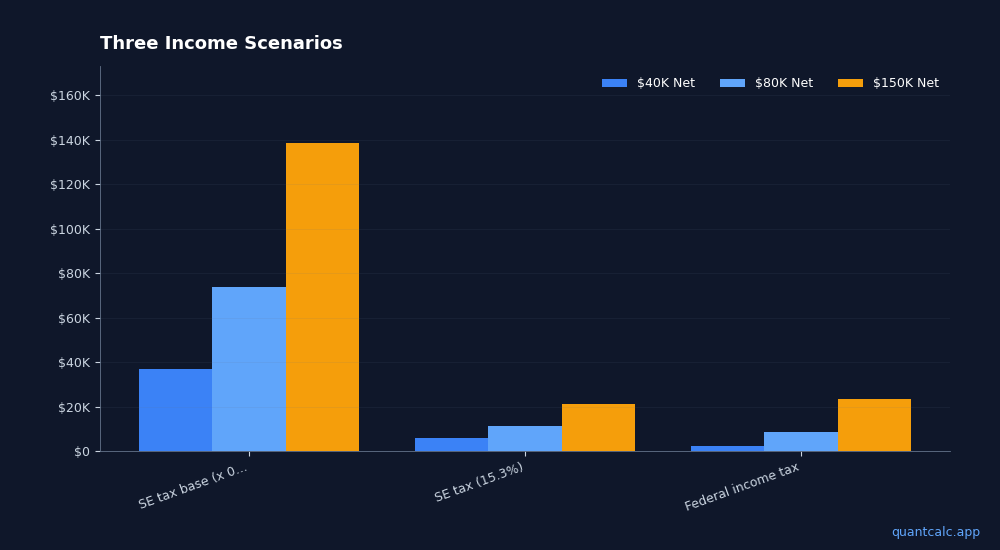
Three Income Scenarios
| $40K Net | $80K Net | $150K Net | |
|---|---|---|---|
| SE tax base (x 0.9235) | $36,940 | $73,880 | $138,525 |
| SE tax (15.3%) | $5,652 | $11,304 | $21,194 |
| Federal income tax | ~$2,281 | ~$7,527 | ~$22,191 |
| Total federal burden | $7,933 | $18,831 | $43,385 |
| Effective rate | 19.8% | 23.5% | 28.9% |
| Quarterly payment | ~$1,983 | ~$4,708 | ~$10,846 |
Single filer, 2026 standard deduction, no QBI deduction or other income. Notice the jump from 19.8% to 28.9% effective rate. Below the Social Security wage base, SE tax is a flat 15.3% of the SE tax base — it takes the same share at $40K as at $150K, so for lower and middle earners it is often the biggest line on the bill. The rising effective rate comes from the progressive income tax stacked on top.
The Deduction Most Freelancers Miss
You can deduct the employer-equivalent portion of your SE tax (50% of the total) from your adjusted gross income. This reduces your income tax, though not your SE tax itself.
In the $80K example: $11,304 / 2 = $5,652 deduction. At the 22% marginal rate, that saves ~$1,243 in income tax. The numbers above already include this deduction.
Safe Harbor: Avoid Underpayment Penalties
The IRS charges penalties if you underpay estimated taxes. The safe harbor rules:
- Pay at least 100% of last year's total tax (110% if AGI > $150,000), OR
- Pay at least 90% of this year's total tax
Meet either threshold and you're penalty-free, even if you owe at filing time.
For first-year freelancers with no prior-year tax liability: you're automatically safe in year one. But set up quarterly payments immediately — year two won't be as forgiving.
Skip the Math
The calculation above is straightforward for a single income stream. It gets complicated when you're stacking W-2 and 1099 income, claiming the QBI deduction, or filing jointly with a working spouse.
Our Freelancer Tax Estimator Chrome extension handles the full calculation — federal income tax, SE tax, state tax (all 50 states), and quarterly estimated payments — in about 60 seconds. Free, no signup required.
For long-term retirement planning that integrates tax-aware withdrawal strategies with Monte Carlo simulation, see QuantCalc.
Related: April 15 Double Deadline: Your 2025 Return AND Q1 2026 Estimated Taxes | IRS Underpayment Penalty 2026 | 2026 Tax Brackets: What OBBBA Actually Changed for Freelancers