IRS Underpayment Penalty 2026: How Much You'll Pay and How to Avoid It
The IRS underpayment penalty rate is 7% annualized for Q1 2026 and 6% for Q2 2026 (Q3 and Q4 are both 7%), as published on irs.gov quarterly interest rates, checked 2026-09-10 — the federal short-term rate plus 3 points, charged per quarter from each missed estimated-tax deadline. Avoid it entirely with a safe harbor: pay 100% of your 2025 tax (110% if AGI exceeded $150,000) or 90% of your 2026 tax in equal quarterly installments; owing under $1,000 at filing also waives it. Project your quarterly payments at quantcalc.app.
The IRS charges an underpayment penalty when you don't pay enough estimated taxes during the year. For 2026, the rate is 7% annually for Q1 and 6% for Q2, with Q3 and Q4 both at 7% — set quarterly at the federal short-term rate plus 3 percentage points, and published on irs.gov quarterly interest rates, checked 2026-09-10.
If you're freelance, self-employed, or have significant investment income without withholding, this penalty applies to you. And the Q2 2026 estimated payment deadline is June 15, 2026.
Here's how the penalty works, how much it costs, and the two legal ways to avoid it entirely.
How the Underpayment Penalty Is Calculated

Run your own numbers — FREE
10,000 Monte Carlo simulations. Forward-looking forecasts from BlackRock, JPMorgan, Vanguard, GMO, Schwab, Invesco. No account needed.
Try QuantCalc Free →The IRS calculates the penalty per quarter, not annually. This is the part most people miss.
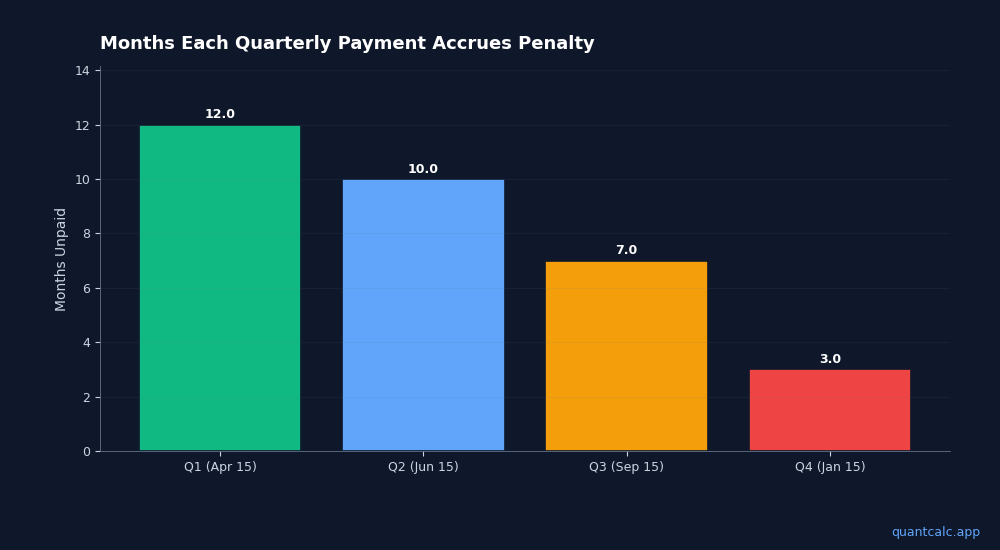
If you owe $20,000 in estimated taxes for 2026 and pay nothing until you file your return in April 2027, the penalty isn't a flat percentage of $20,000. It's charged on each quarter's underpayment separately, running from the date each payment was due, at whatever rate the IRS publishes for each quarter (irs.gov quarterly interest rates, checked 2026-09-10).
Example (using the Q1 2026 rate of 7% throughout, for illustration):
- Q1 payment due April 15: $5,000 — unpaid for 12 months
- Q2 payment due June 15: $5,000 — unpaid for 10 months
- Q3 payment due September 15: $5,000 — unpaid for 7 months
- Q4 payment due January 15: $5,000 — unpaid for 3 months
Total penalty: roughly $930 on $20,000 owed — somewhat less if later quarters keep the lower 6% rate. That's money the IRS takes with no negotiation.
Run your own numbers in the free calculator →
The Two Safe Harbors (How to Pay Zero Penalty)
The IRS provides two safe harbor rules. Hit either one and the underpayment penalty drops to $0 — even if you end up owing a large balance at filing time.
Safe Harbor 1: 100% of Last Year's Tax
Pay 100% of your 2025 tax liability in four equal quarterly installments during 2026.
Find your 2025 total tax on Line 24 of Form 1040. Divide by 4. Pay that amount each quarter (April 15, June 15, September 15, January 15).
If your 2025 AGI exceeded $150,000 ($75,000 if married filing separately), the threshold increases to 110% of last year's tax.
This is the easiest safe harbor because it doesn't require you to estimate your 2026 income at all. You use a known number from last year.
Safe Harbor 2: 90% of Current Year's Tax
Pay at least 90% of your actual 2026 tax liability through estimated payments and withholding.
This requires accurately projecting your 2026 income — harder for freelancers with variable income, but potentially lower payments if your income dropped from last year.
When the Penalty Doesn't Apply
The IRS waives the penalty if:
- You owe less than $1,000 when you file your return
- Your withholding covers 90%+ of your current year tax
- You're a farmer or fisherman (special rules apply)
- You had a casualty, disaster, or unusual circumstance (must request waiver via Form 2210)
If you had a W-2 job for part of the year and switched to freelancing, your W-2 withholding may cover enough to avoid the penalty. Check before making a separate estimated payment.
Quarterly Deadlines for 2026
| Quarter | Income Period | Due Date |
|---|---|---|
| Q1 | Jan 1 - Mar 31 | April 15, 2026 |
| Q2 | Apr 1 - May 31 | June 15, 2026 |
| Q3 | Jun 1 - Aug 31 | September 15, 2026 |
| Q4 | Sep 1 - Dec 31 | January 15, 2027 |
Note Q2 only covers 2 months, while Q3 covers 3 months. The IRS schedule is not evenly split.
How to Calculate Your Next Payment Right Now
If you want to use the 100% safe harbor (the simple approach):
- Pull up your 2025 Form 1040
- Find Line 24 (total tax)
- Divide by 4
- Pay that amount by each quarterly deadline — the next one is June 15, 2026
If you want a precise calculation based on your actual 2026 freelance income so far, our Freelancer Tax Estimator Chrome extension computes your federal, SE tax, state tax, and quarterly estimated payment in 60 seconds. Free, no signup.
Don't Wait Until Year-End
The worst strategy is ignoring estimated taxes until you file your return. The IRS penalty is per-quarter, which means the Q1 underpayment accrues penalties for 12 full months. Paying even a rough estimate on time is better than paying the exact amount late.
If you can't calculate precisely, use the safe harbor. Pay what you paid last year. It's the safest play with zero downside.
Related: April 15 Double Deadline: Your 2025 Return AND Q1 2026 Estimated Taxes | 2026 Estimated Tax Payment Schedule | Side Hustle Tax Guide 2026