April 15 Double Deadline: Return AND Q1 Estimated Taxes
April 15, 2026 is not one deadline. It's two.
Most freelancers and self-employed workers know they need to file their 2025 federal tax return by April 15. What many miss — especially those new to self-employment — is that the Q1 2026 estimated tax payment is due on the exact same day.
If you earn income without withholding (freelance, gig work, 1099 contracts, investment income), the IRS expects you to pay taxes quarterly. Miss it, and you'll owe penalties — even if you pay the full amount later.
Here's what you need to know before the deadline.
The Two Deadlines on April 15, 2026

Run your own numbers — FREE
10,000 Monte Carlo simulations. Forward-looking forecasts from BlackRock, JPMorgan, Vanguard, GMO, Schwab, Invesco. No account needed.
Try QuantCalc Free →Deadline 1: File your 2025 tax return (or request an extension)
This is the one everyone remembers. Your Form 1040 for tax year 2025 is due. If you can't file, you can request a 6-month extension — but you still owe any taxes by April 15.
Deadline 2: Pay your Q1 2026 estimated taxes
This covers income earned from January 1 through March 31, 2026. If you expect to owe $1,000 or more for 2026, the IRS requires quarterly payments. The Q1 voucher (Form 1040-ES) is due April 15.
Many freelancers get so focused on their 2025 return that they forget to calculate and send the Q1 2026 payment. Don't be one of them.
Run your own numbers in the free calculator →
Who Needs to Pay Estimated Taxes?
You likely need to make estimated tax payments if:
- You're a freelancer, independent contractor, or gig worker
- You have significant investment income (dividends, capital gains)
- You're self-employed and don't have an employer withholding taxes
- You expect to owe $1,000 or more when you file your 2026 return
The threshold is straightforward: if your total tax minus withholding and credits will be $1,000+, you need to pay quarterly.
The Hidden Tax New Freelancers Miss
Here's where first-time freelancers get burned: self-employment tax.
On top of your regular income tax, self-employed workers pay a 15.3% SE tax on net earnings. This covers both the employer and employee portions of Social Security (12.4%) and Medicare (2.9%) that W-2 workers split with their employer.
If you earned $80,000 freelancing in Q1, your estimated payment needs to cover both your income tax bracket AND 15.3% SE tax. Budget for a combined effective rate of 25-35% depending on your bracket — not just your marginal income tax rate.
The Safe Harbor Rule (Your Penalty Shield)
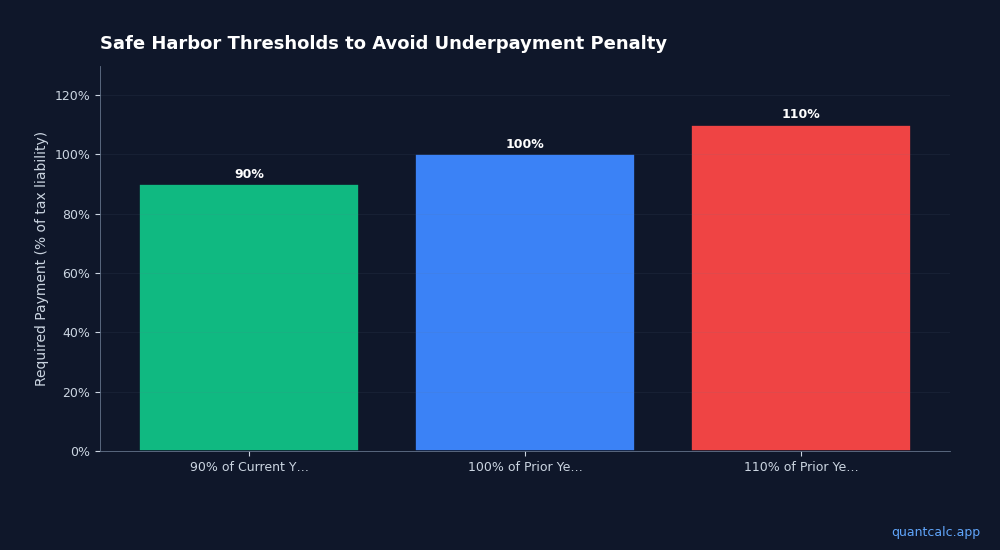
The IRS won't penalize you for underpayment if you meet either safe harbor threshold:
- Pay 100% of last year's tax liability divided into four equal quarterly payments
- Pay 90% of this year's actual tax liability as you go
If your AGI exceeded $150,000 last year, the first threshold bumps to 110% of last year's liability.
The simplest approach: take your 2025 total tax from Line 24 of your 1040, divide by 4, and pay that amount each quarter. You'll never owe a penalty, and if you overpay, you get it back as a refund.
Penalties Are Per-Quarter (Not Annual)
This catches people off guard. The IRS calculates underpayment penalties for each quarter individually. If you skip Q1 and Q2, then make a large Q3 payment, you'll still owe penalties for the first two quarters.
The current underpayment penalty rate is tied to the federal short-term rate plus 3 percentage points. It's not catastrophic, but it's completely avoidable.
How to Calculate Your Q1 Payment
Option 1: Use last year's tax as a baseline
Take your 2025 total tax, divide by 4. Pay that amount. Done.
Option 2: Estimate based on Q1 income
If your 2026 income differs significantly from 2025, calculate your projected annual income, apply 2026 tax brackets (TCJA brackets made permanent by OBBBA), add SE tax, subtract any withholding, and divide by 4.
For freelancers juggling multiple income streams — W-2 salary plus 1099 side income — the math gets more complex. Our Freelancer Tax Estimator Chrome extension handles the calculation automatically: enter your income sources, and it computes your quarterly estimated payments including SE tax.
How to Pay
Four options, all free:
- IRS Direct Pay (irs.gov/payments/direct-pay) — bank transfer, no registration
- EFTPS (eftps.gov) — requires enrollment, allows scheduled payments
- IRS2Go app — mobile payments via bank account or card
- Check + Form 1040-ES voucher — mail to the address on the voucher
Mark April 15 on your calendar twice. Your 2025 return AND your Q1 2026 estimated payment. Both due. Both avoidable penalties if you miss them.
What's Next
The remaining 2026 estimated tax deadlines are:
- Q2: June 15, 2026
- Q3: September 15, 2026
- Q4: January 15, 2027
Plan now, pay on time, and never worry about IRS penalty letters. For a quick estimate of what you owe, try our freelancer tax calculator — it takes under 60 seconds.