Freelancer vs. W-2 Employee: Your Tax Bill Is 15.3% Higher (Fix It)
Leaving a W-2 job for freelancing changes your tax situation in ways most people don't anticipate until their first estimated tax payment is due.
The biggest surprise? Self-employment tax. As a freelancer, you pay both the employee AND employer portions of Social Security and Medicare — a combined 15.3% that W-2 workers split with their employer.
Here's what that looks like in real dollars, and what you can do about it.
The 15.3% Self-Employment Tax Gap

Run your own numbers — FREE
10,000 Monte Carlo simulations. Forward-looking forecasts from BlackRock, JPMorgan, Vanguard, GMO, Schwab, Invesco. No account needed.
Try QuantCalc Free →When you work as a W-2 employee, your employer pays half of your FICA taxes:
- Employee pays: 6.2% Social Security + 1.45% Medicare = 7.65%
- Employer pays: 6.2% Social Security + 1.45% Medicare = 7.65%
As a freelancer, you pay both halves. The IRS calls this Self-Employment Contribution Act (SECA) tax, and it applies to 92.35% of your net self-employment earnings.
The Social Security portion (12.4%) applies only up to the wage base limit — $184,500 in 2026. Medicare (2.9%) has no cap, and an Additional Medicare Tax of 0.9% kicks in above $200,000 (single) or $250,000 (married filing jointly).
Run your own numbers in the free calculator →
Side-by-Side: Same Income, Different Tax Bills
Here's what a single filer with no dependents pays in 2026 at three income levels (using standard deduction of $15,400):
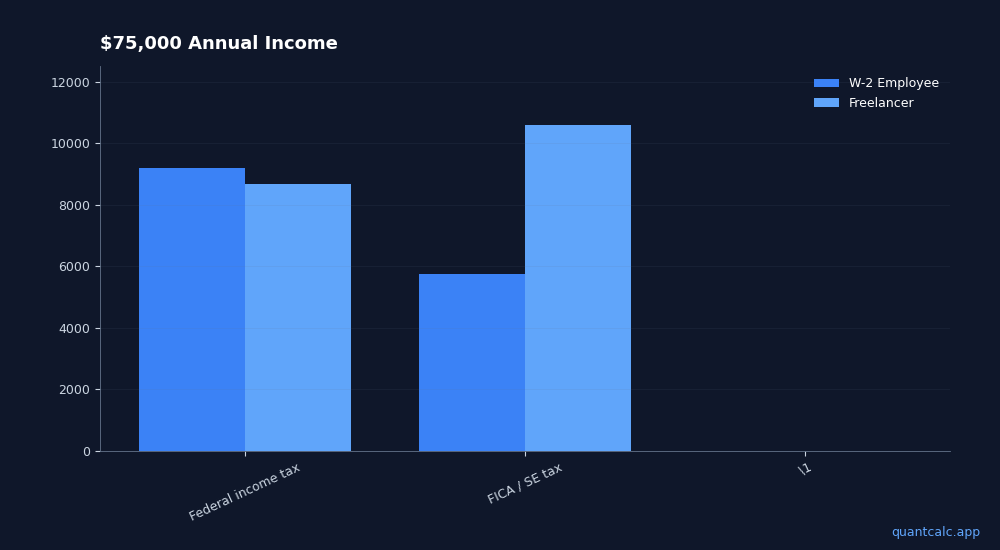
$75,000 Annual Income
| W-2 Employee | Freelancer | |
|---|---|---|
| Federal income tax | $9,181 | $8,667* |
| FICA / SE tax | $5,738 | $10,597 |
| Total federal tax | $14,919 | $19,264 |
*Freelancer income tax is lower because half of SE tax is deductible above the line.
Freelancer pays $4,345 more per year.
$100,000 Annual Income
| W-2 Employee | Freelancer | |
|---|---|---|
| Federal income tax | $13,842 | $12,922* |
| FICA / SE tax | $7,650 | $14,130 |
| Total federal tax | $21,492 | $27,052 |
Freelancer pays $5,560 more per year.
$150,000 Annual Income
| W-2 Employee | Freelancer | |
|---|---|---|
| Federal income tax | $24,842 | $23,140* |
| FICA / SE tax | $11,475 | $21,194 |
| Total federal tax | $36,317 | $44,334 |
Freelancer pays $8,017 more per year.
These numbers use 2026 OBBBA/TCJA tax brackets (made permanent by the One Big Beautiful Bill Act, signed July 2025). Brackets did not revert to pre-2017 rates.
Three Legal Strategies to Reduce the Gap
1. Deduct Half Your SE Tax Above the Line
The IRS lets you deduct 50% of your self-employment tax from your adjusted gross income. This doesn't reduce the SE tax itself — it reduces your income tax.
At $100,000 in freelance income, this saves approximately $1,340 in federal income tax.
This deduction is automatic when you file Schedule SE. You don't need to itemize.
2. Max Out Retirement Contributions
A Solo 401(k) lets you contribute as both employee and employer:
- Employee contribution: Up to $24,500 in 2026 ($32,500 if 50+)
- Employer contribution: Up to 20% of net self-employment earnings (after the SE tax deduction)
On $100,000 net earnings, you could shelter roughly $42,960 from income tax. That's a reduction of approximately $9,450 in federal income tax at the 22% bracket.
A SEP-IRA is simpler to set up but limits you to the employer contribution only (20% of net SE earnings).
3. Consider S-Corp Election (Above ~$50K Net Profit)
If your net self-employment profit consistently exceeds $50,000, an S-Corp election lets you split income between a "reasonable salary" (subject to FICA) and distributions (not subject to SE tax).
Example: On $100,000 net profit, paying yourself a $60,000 salary and taking $40,000 as distributions saves approximately $6,120 in SE tax — minus additional payroll processing costs (~$500-1,500/year).
Warning: The IRS scrutinizes unreasonably low salaries. Your salary must reflect what you'd pay someone to do your job. Consult a CPA before making this election.
What About State Taxes?
State income tax adds another layer. Nine states have no income tax (Alaska, Florida, Nevada, New Hampshire, South Dakota, Tennessee, Texas, Washington, Wyoming). The rest range from about 1% to 13.3% (California's top rate).
State taxes apply equally to W-2 and freelance income in most states — the gap is primarily at the federal level due to SE tax.
Calculate Your Actual Numbers
The math changes at every income level. The Social Security wage base cap, the half-SE-tax deduction, QBI deduction eligibility, and state tax rates all interact.
Rather than estimating, run your specific numbers. The Freelancer Tax Estimator calculates your federal and SE tax in seconds using current 2026 brackets. The free version handles federal; the PRO version ($4.99) adds all 50 states and W-2 + 1099 stacking for side hustlers.
The Bottom Line
Freelancing typically costs 15.3% more in federal taxes on the first ~$176K of earnings. The half-SE-tax deduction softens the blow by about 10-15%, and retirement contributions can shelter significant income from taxation.
The real question isn't whether freelancers pay more — they do. It's whether the additional tax cost is worth the flexibility, earning potential, and autonomy. For most successful freelancers, the answer is yes — as long as they're actually planning for it.
Related reading:
- Estimated Tax Penalties: How Much the IRS Actually Charges in 2026
- How to Calculate Self-Employment Tax in 2026
- Side Hustle Estimated Tax Payments: A Complete 2026 Guide
- 11 Self-Employment Tax Deductions That Lower Your Quarterly Payments
- How to Calculate Q1 2026 Estimated Tax Payments
Frequently Asked Questions
Do freelancers pay more taxes than W-2 employees?
Yes. Freelancers pay both halves of FICA (15.3% self-employment tax) on net income. W-2 employees split FICA with employers (7.65% each).
Can freelancers deduct business expenses?
Yes. Home office, equipment, mileage, software, and professional development are deductible against self-employment income. W-2 employees can't deduct unreimbursed expenses.
What is the QBI deduction for freelancers?
Qualified Business Income deduction allows up to 20% of net self-employment income as a deduction (subject to phaseouts above $201,750 single / $403,500 married in 2026).
Frequently Asked Questions
Yes. Freelancers pay both halves of FICA (15.3% self-employment tax) on net income. W-2 employees split FICA with employers (7.65% each).
Yes. Home office, equipment, mileage, software, and professional development are deductible against self-employment income. W-2 employees can't deduct unreimbursed expenses.
Qualified Business Income deduction allows up to 20% of net self-employment income as a deduction (subject to phaseouts above $201,750 single / $403,500 married in 2026).