SALT Deduction Cap Raised to $40,400 in 2026: What FIRE Planners Need to Know
The One Big Beautiful Bill Act (OBBBA), signed July 4, 2025, quietly changed a number that matters to every FIRE planner in a high-tax state: the SALT deduction cap jumped from $10,000 to $40,000 for 2025 and $40,400 for 2026.
If you live in California, New York, New Jersey, Connecticut, or any other state with significant income and property taxes, this changes your tax math for 2026 and beyond.
Here is what it means, who benefits, and how to incorporate it into your withdrawal strategy.
What Changed

Run your own numbers — FREE
10,000 Monte Carlo simulations. Forward-looking forecasts from BlackRock, JPMorgan, Vanguard, GMO, Schwab, Invesco. No account needed.
Try QuantCalc Free →The Tax Cuts and Jobs Act of 2017 capped the state and local tax (SALT) deduction at $10,000 ($5,000 for married filing separately). The OBBBA made the TCJA brackets permanent and raised the SALT cap to $40,000 for 2025 and $40,400 for 2026, growing 1% a year through 2029 and falling back to $10,000 from 2030 (IRC §164(b)(7)). The cap is reduced by 30% of modified adjusted gross income (MAGI) over $500,000 for 2025 and $505,000 for 2026, but never below $10,000.
Key details:
- New cap: $40,400 for 2026 ($20,200 MFS); $40,000 for 2025
- Income limit: the cap shrinks by 30% of MAGI over $505,000 for 2026 ($252,500 MFS; $500,000 for 2025), down to a $10,000 floor
- What counts: State income tax + local income tax + property tax, combined
- Effective date: Tax years 2025 through 2029 ($40,000 for 2025, so it already applies to the 2025 return you file in 2026); the cap returns to $10,000 from 2030
Run your own numbers in the free calculator →
Why It Matters for FIRE Planners
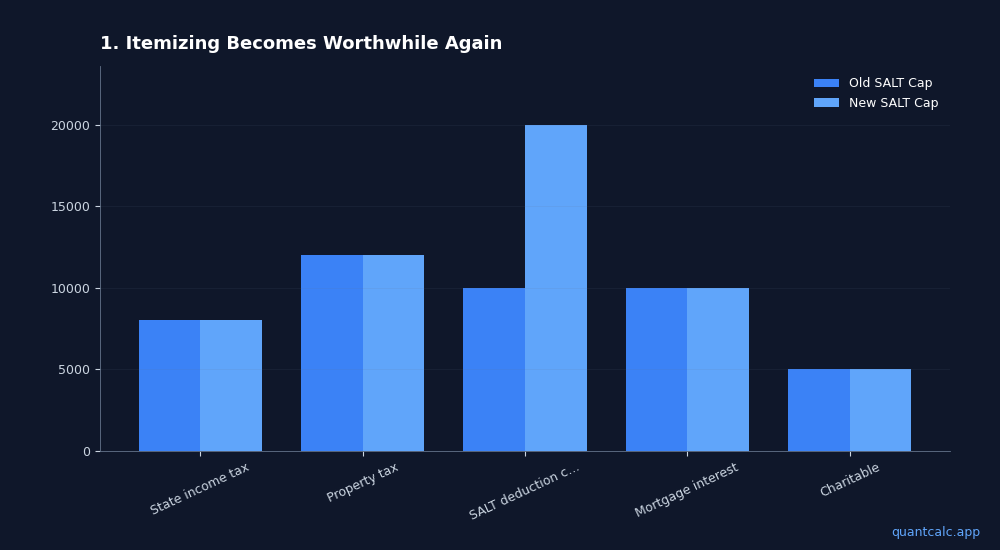
1. Itemizing Becomes Worthwhile Again
Under the $10,000 cap, many FIRE planners in high-tax states could not itemize. The 2026 standard deduction is $32,200 (MFJ) or $16,100 (single). With only $10,000 of SALT plus maybe $8,000-$12,000 in mortgage interest, you stayed below the standard deduction.
At a $40,400 SALT cap, the math changes, but two other 2026 rules from the same law change it too. Cash gifts to charity count on Schedule A only above 0.5% of your AGI (IRC §170(b)(1)(I): gifts are allowed “only to the extent that the aggregate of such contributions exceeds 0.5 percent of the taxpayer's contribution base”). And if you take the standard deduction, you can now deduct up to $2,000 ($1,000 single) of cash gifts on top of it (IRC §170(p)). Example: a married couple in California with $180,000 of AGI, both under 65, 2026 law:
| Scenario (MFJ, California, AGI $180,000) | If the cap had stayed $10,000 | 2026 law ($40,400 cap) |
|---|---|---|
| State income tax | $8,000 | $8,000 |
| Property tax | $12,000 | $12,000 |
| SALT deduction claimed | $10,000 | $20,000 |
| Mortgage interest | $10,000 | $10,000 |
| Charitable ($5,000 given, less the 0.5% floor of $900) | $4,100 | $4,100 |
| Total itemized | $24,100 | $34,100 |
| Standard deduction + up to $2,000 of cash gifts | $34,200 | $34,200 |
| Better choice | Standard, by $10,100 | Standard, by $100 |
The higher cap closes almost all of the gap, but in this example it is not quite enough: the floor trims $900 from the gift, and the standard-deduction side now gets $2,000 of it anyway. With $12,000 of mortgage interest instead of $10,000, itemizing wins: $36,100 against $34,200, which saves $418 of federal tax at the 22% bracket. The floor grows with your income (it is $2,000 at $400,000 of AGI), so run your own numbers rather than assuming the higher cap tips you into itemizing.
2. Roth Conversion Math Gets More Nuanced
The higher SALT cap interacts with Roth conversion planning in an important way. During your early retirement conversion years (typically age 55-72 before RMDs), every dollar of Roth conversion increases your MAGI. Higher MAGI means higher state tax.
Previously, the $10,000 SALT cap meant you could not deduct much of that state tax anyway — so the state tax cost of Roth conversions was essentially "lost."
Now, with a $40,400 cap, the state tax from your Roth conversions may be deductible. This effectively reduces the federal cost of conversion:
Example: You convert $80,000 from Traditional IRA to Roth in California (9.3% state bracket).
- State tax on conversion: $7,440
- Under old SALT cap ($10K): likely already maxed by property tax alone. No additional federal benefit.
- Under new SALT cap ($40,400 for 2026): $7,440 is deductible. Federal tax savings at 22% bracket = $1,637.
That $1,637 makes the Roth conversion 2% cheaper in effective terms. Over a 10-year conversion ladder, this adds up.
3. ACA Cliff Interaction
For early retirees managing MAGI to stay under the ACA 400% FPL cliff, the SALT change does NOT directly help — SALT deductions reduce taxable income, not MAGI. Your MAGI stays the same regardless of itemization.
However, if you are above the ACA cliff and optimizing for lowest total tax, the additional SALT deduction reduces your federal tax burden, partially offsetting the loss of ACA subsidies.
4. Property Tax Planning
FIRE planners who geoarbitrage — moving from a high-cost area to a lower-cost area — should recalculate. If your property taxes are $15,000-$25,000 in a HCOL area, the higher SALT cap now lets you deduct all of it rather than being capped at $10,000. This slightly reduces the tax incentive to relocate purely for property tax reasons, though cost of living differences still dominate the math.
Who Benefits Most
The $40,400 SALT cap primarily benefits:
- High-tax state residents with property. If your combined state income tax + property tax exceeds $10,000 (very common in CA, NY, NJ, CT, MA, IL), you now get a larger deduction.
- FIRE planners doing Roth conversions in high-tax states. The state tax on conversions is now deductible at the federal level.
- Anyone whose itemized deductions were just below the standard deduction. The extra SALT headroom may push you over the itemization threshold.
- Semi-retired workers in high-tax states. Part-time income + investment income + state tax now gives more room to itemize.
Who does NOT benefit:
- Low-tax or no-income-tax state residents (FL, TX, WA, NV, TN, WY, SD, AK, NH). If your total SALT was under $10,000 before, nothing changes.
- Anyone with MAGI above $505,000 (2026). The cap shrinks by 30% of the excess, to no less than $10,000.
- Standard deduction takers whose total itemized deductions still fall short even with the higher SALT allowance.
What to Do Before April 15
If you are filing your 2025 taxes right now and simultaneously planning your 2026 strategy:
- Recalculate your 2026 itemization math with the $40,400 SALT cap. You may switch from standard deduction to itemized for the first time since 2017.
- Re-evaluate your Roth conversion amount for 2026. The deductibility of state tax on conversions may allow a slightly larger conversion before you hit your target effective tax rate.
- Review your estimated tax payments — if you are switching to itemized deductions, your 2026 federal tax may be lower than expected. Adjust Q2 estimated payment accordingly.
- Check if your tax-efficient withdrawal strategy needs updating. The SALT interaction with Roth conversions, capital gains, and ACA planning adds a new variable.
Run the Numbers
The interaction between SALT deductions, Roth conversions, ACA subsidies, and IRMAA thresholds is exactly the kind of multi-variable problem that Monte Carlo simulation can model. A $1,600 annual tax savings from SALT deductibility, compounded over a 10-year Roth conversion ladder, can add $20,000+ to your retirement portfolio.
QuantCalc PRO runs 10,000 Monte Carlo simulations with forward-looking forecasts from CME, BlackRock, JPMorgan, Vanguard, GMO, Schwab, and Invesco — helping you stress-test exactly these scenarios. Try it free at quantcalc.app.
The SALT deduction cap is $40,000 for tax year 2025 and $40,400 for tax year 2026 under IRC §164(b)(7), added by the One Big Beautiful Bill Act (OBBBA), signed July 4, 2025. This content is for educational purposes only and is not tax or financial advice. Consult a qualified tax professional for your specific situation.