Which states are best and worst for retirement taxes, on a full Monte Carlo plan?
Best: the thirteen jurisdictions where this retiree pays $0 of state tax over 30 years — the nine with no income tax plus Illinois, Iowa, Mississippi and Pennsylvania, which exempt qualified retirement income outright. Wyoming leads at a 77.11% success rate, followed by Washington (76.63%), South Dakota (76.55%), Pennsylvania (76.53%) and Mississippi (76.51%); the whole top 10 sits within 1.12 percentage points, inside the simulation's own sampling noise. Worst: California at 69.03% success and $154,980 of median lifetime state tax, then the District of Columbia (69.33%), New York (69.62%) and Hawaii (70.32% — it taxes 401(k) and IRA withdrawals at up to 11.00% even though it exempts pensions). The best-to-worst spread is 8.08 percentage points for an identical retiree (age 60, $2M, 60/40, $80,000 real spend, 10,000 paths per jurisdiction on each state's 2026 schedule; revised 2026-08-23, v2026.2) — see the top 10, the bottom 10 and the full ranking.
Key numbers — each row links to the section that carries the full table. Updated 2026-09-07; data unchanged since v2026.2.
| Key number | Value | Where on this page |
|---|---|---|
| Best jurisdiction — Wyoming: success rate / median 30-year state tax | 77.11% / $0 | Top 10 |
| Worst jurisdiction — California: success rate / median 30-year state tax | 69.03% / $154,980 | Bottom 10 |
| Best-to-worst spread: success rate / lifetime state tax | 8.08 pp / $154,980 | Why the gap is bigger than it looks |
| Jurisdictions where this retiree pays $0 of state tax (no income tax, or qualified retirement income exempt) | 13 of 51 | Top 10 |
| Spread inside the top 10 (within sampling noise) | 1.12 pp | Top 10 |
| Hawaii — exempts pensions but taxes 401(k)/IRA withdrawals (top rate 11.00%): success rate / state tax / rank | 70.32% / $138,600 / 48th of 51 | Bottom 10 |
| Mid-table band (positions 11–41), success rate | 72.60%–75.93% | The full ranking |
| Simulated retirements | 510,000 paths (10,000 per jurisdiction, 30-year horizon) | Methodology |
We ran a 30-year Monte Carlo retirement simulation 10,000 times for each of the 50 U.S. states plus the District of Columbia — 510,000 paths total — for an identical representative retiree (age 60, $2M starting balance, 60% stocks / 40% bonds, $80,000 real annual spend). The only variable that changed between runs was the state of residence. State income tax on traditional retirement-account withdrawals was modeled per-state from each jurisdiction's 2026 bracket schedule and its retirement-income exemption rules, both read from the same state-tax engine that powers the QuantCalc calculators. Here is what we found.
Headline finding: Identical retiree, identical portfolio, identical spending. Wyoming finishes 30 years at 77.11% success. California finishes at 69.03% — an 8.08 percentage-point gap, with $154,980 more paid in lifetime state tax. The cost of geography is real, and it compounds.
This page was revised on 2026-08-23. The per-state tax inputs were corrected and the study re-run; nineteen jurisdictions had carried a rate or an exemption flag that differed from the published 2026 schedule. Hawaii and Louisiana moved the most — both were treated as exempting 401(k) and IRA withdrawals, and neither does. Every figure below comes from the corrected run. The full list of what moved is in the changelog.
Top 10 retirement-friendly states (by Monte Carlo success rate)
The top of the table is filled entirely by jurisdictions where this retiree's state tax bill is $0 — the nine with no income tax, plus the four that exempt qualified retirement income outright. Wyoming led at 77.11%, but the spread among the top 10 was tight: 1.12 percentage points, which is close to the run-to-run noise of a 10,000-path simulation. Read the top of this table as a band, not a race.
| # | State | Success rate | Median state tax (30y) | Median terminal balance |
|---|---|---|---|---|
| 1 | Wyoming | 77.11% | $0 | $999,751 |
| 2 | Washington | 76.63% | $0 | $1,016,505 |
| 3 | South Dakota | 76.55% | $0 | $1,009,444 |
| 4 | Pennsylvania | 76.53% | $0 | $995,266 |
| 5 | Mississippi | 76.51% | $0 | $987,119 |
| 6 | Texas | 76.25% | $0 | $1,020,142 |
| 7 | Iowa | 76.19% | $0 | $969,132 |
| 8 | New Hampshire | 76.14% | $0 | $981,942 |
| 9 | Alaska | 76.00% | $0 | $972,083 |
| 10 | Illinois | 75.99% | $0 | $972,093 |
The rate on the tin is not the rate a retiree pays. Pennsylvania, Mississippi, Illinois and Iowa all levy an income tax — 3.07%, 4.00%, 4.95% and 3.80% respectively — and all four cost this retiree nothing, because each exempts qualified retirement income outright (Iowa from age 55). Four states with a tax rate sit alongside the nine with none.
The same logic runs the other way, and it is the sharper edge. Hawaii has the second-highest top marginal rate in the country at 11.00%, and it applies to 401(k) and IRA withdrawals. Hawaii exempts employer-funded pensions and Social Security — not retirement-account distributions — so a retiree drawing from an IRA there pays $138,600 over 30 years and finishes 48th of 51. Louisiana, at a much gentler 3.00%, taxes those distributions too: $37,800 over 30 years, 20th of 51. Neither is a state-tax-free retirement, and the headline rate alone would not have told you which was which.
Bottom 10 retirement-friendly states (the high-tax tail)
California led the bottom on every metric tracked: lowest success rate (69.03%), highest median lifetime state tax ($154,980), highest median total tax ($373,380).
| # | State | Success rate | Median state tax (30y) | Median total tax (30y) |
|---|---|---|---|---|
| 51 | California | 69.03% | $154,980 | $373,380 |
| 50 | District of Columbia | 69.33% | $135,450 | $353,850 |
| 49 | New York | 69.62% | $137,340 | $355,740 |
| 48 | Hawaii | 70.32% | $138,600 | $357,000 |
| 47 | Minnesota | 70.45% | $124,110 | $342,510 |
| 46 | New Jersey | 70.57% | $135,450 | $353,850 |
| 45 | Oregon | 70.62% | $124,740 | $343,140 |
| 44 | Wisconsin | 72.11% | $96,390 | $314,790 |
| 43 | Connecticut | 72.35% | $88,074 | $306,474 |
| 42 | Vermont | 72.39% | $110,250 | $328,650 |
The bottom 10 is the high-tax coastal group, the upper-Midwest exception of Minnesota and Wisconsin, and Hawaii. New Jersey and New York both have generous retirement-income exclusions ($100K-150K), but for a retiree whose withdrawals exceed those thresholds, the top rates (10.75% and 10.90% respectively) dominate the calculation.
Massachusetts is not on this list, and that is worth a sentence. Its schedule is a single 5.00% bracket, with a separate 4% surcharge that begins above $1,107,750 of income. This retiree's ordinary income is $56,000 a year, so the surcharge never applies: Massachusetts costs $63,000 over 30 years and finishes 32nd, mid-table. California's headline 13.30% works the same way — 12.30% of it is the bracket schedule and 1.00% is a surcharge above $1,000,000, so the figure in the table is built from 12.30%.
Why the gap is bigger than it looks
The 8.08 percentage-point success-rate spread understates the lived difference for two reasons. First, the comparison is across median outcomes — in the worst 10% of stochastic paths, the high-tax states fail much earlier because tax drag compounds against sequence-of-returns risk. Second, the model does not include the 400% FPL ACA cliff cost during pre-Medicare years (60-64), which adds approximately $12,000/year in foregone premium tax credit for households whose taxable withdrawal grosses them over the cliff. California, New York, and New Jersey retirees on Marketplace coverage face the federal cliff plus the highest state tax on the conversion-or-withdrawal income that triggers it.
The full ranking
Full 51-jurisdiction CSV and JSON datasets are linked below. Mid-table states (positions 11-41) clustered between 72.60% and 75.93% success and showed a strong correlation between state tax burden and success-rate degradation. The CSV carries each jurisdiction's bracket rate and, separately, any top-of-schedule surcharge, so the exact input behind every dollar figure is visible in the data rather than only described here.
CC-BY-4.0 — free for any use including republication and journalism, with attribution to QuantCalc Research.
For finance bloggers and journalists
The findings above are linkable, citable, and licensed for reuse. If you cover retirement, FIRE, the ACA cliff, or state-by-state tax migration, you can quote any number on this page or reuse the dataset directly — please link back to this page as the source. If you would like a custom cut of the data (different starting balance, different spend, different portfolio mix, including ACA cliff explicitly), email [email protected] and we will rerun and publish a follow-up.
Cite this study
Copy the citation (plain text):
QuantCalc Research (2026). 51-State Retirement Monte Carlo Results 2026. 510,000 simulated retirements. https://quantcalc.app/research/51-state-tax-mc-2026/
Or paste this ready-made attribution link into your article (HTML):
Source: <a href="https://quantcalc.app/research/51-state-tax-mc-2026/">QuantCalc 51-State Retirement Monte Carlo (2026)</a>
Reuse is licensed under CC BY 4.0 — the only condition is a visible credit linking back to this page.
Methodology
Portfolio: 60% stocks / 40% bonds. Stocks: 5.5% real geometric expected return, 16% volatility. Bonds: 2.0% real, 6% volatility. Independent annual draws (the full QuantCalc app applies the JPM correlation matrix; that is omitted at the research-summary level for tractability).
Retiree: Age 60 at start, plans to age 90 (30 years). $2,000,000 starting balance. $80,000 real annual spending — the 4% rule baseline. Spending is held constant in real terms; the model is in real dollars so inflation is implicit in the real-return assumption.
Withdrawal: Constant real $80K/yr. 70% of withdrawal treated as ordinary income (proxy for traditional-account mix); 30% as basis-return non-taxable. Federal effective tax rate 13% on ordinary portion (representative MFJ with standard deduction). State tax modeled per-state at 75% of the state's top bracket rate — the 0.75 factor is a proxy for standard deductions, retirement-income exclusions and the lower brackets a real return steps through — and set to zero where the state exempts qualified retirement income outright.
Which rate: the top rate of each jurisdiction's bracket schedule. Two jurisdictions levy a flat surcharge above a seven-figure threshold — California adds 1.00% above $1,000,000 and Massachusetts 4.00% above $1,107,750 — so their often-quoted "top marginal rates" of 13.30% and 9.00% are rates this retiree's $56,000 of annual ordinary income never reaches. Both surcharges are carried in the dataset's surtax_rate column and are not applied. Rates and exemption rules for all 51 jurisdictions are read from the same state-tax engine the QuantCalc calculators run on, and published in the 2026 state retirement tax dataset.
States with full retirement-income exemption (treated as state-tax-free for traditional withdrawals in this study): Illinois, Iowa (age 55+), Mississippi, Pennsylvania. Hawaii and Louisiana are not on this list — Hawaii exempts employer-funded pensions and Social Security but taxes 401(k) and IRA distributions, and Louisiana grants only a capped exclusion from age 65.
ACA cliff: Tracked for years 60-64 (pre-Medicare). 400% FPL threshold for household of 2 in 2026 = $84,600. Households crossing the cliff lose $12,000/yr premium tax credit. ACA clawback is included in the "Median total tax (30y)" column but does not affect success rate in the published simulation (because the spend assumption is fixed at $80K and the cliff is treated as an opportunity cost rather than a hard balance drain). A future iteration will fold the cliff into the success-rate model directly.
Reproducibility: Random seed fixed at 20260512. Every figure quoted in the text, every table row and every chart on this page is read from the CSV and JSON linked above, which are the direct output of the simulation described here. The datasets are stamped version 2026.2.
Limitations: Single representative retiree — no parameter sweep across starting balances or spend levels. State tax modeled at bracket-rate-times-0.75; bracket-precise modeling would shift mid-tax states by ±0.5pp. ACA cliff modeled as binary; in reality, partial subsidy phaseouts exist below the 400% FPL boundary. Social Security claiming, Roth conversions, and asset-location are not optimized — the full QuantCalc app models these. Success rates carry Monte Carlo sampling error of roughly ±0.4pp at 10,000 paths, which is wider than the gaps separating the jurisdictions at the top of the table: treat those as a tie, not an ordering.
Run your own state-by-state retirement scenario
The full QuantCalc app models all 51 jurisdictions, ACA cliff, IRMAA, Roth conversion optimizer, and stochastic inflation. Free 10,000-path simulation in your browser.
Run a free simulation →Shareable insight cards
Single-image data summaries derived from this study. CC-BY-4.0 like the dataset itself — right-click any card to save, embed, or share. If you republish, please link back to this page as the source.
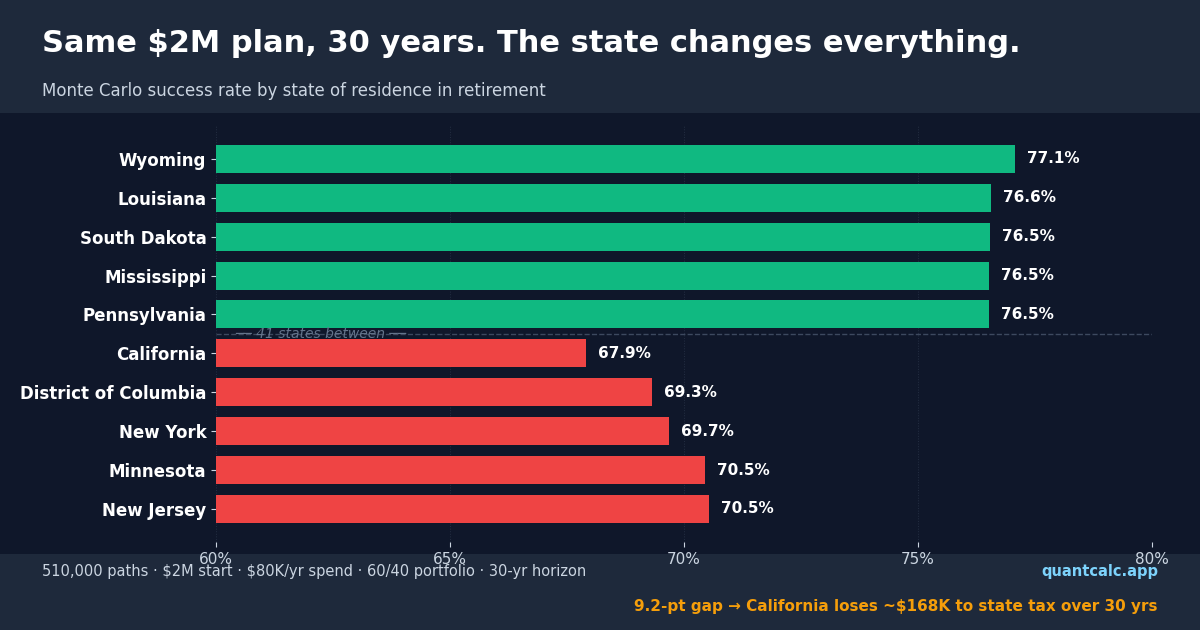
Same $2M plan, 30 years — the state changes everything
8.08-pt success-rate spread between best (Wyoming, 77.11%) and worst (California, 69.03%) on identical 60/40, $80K-spend retirement.
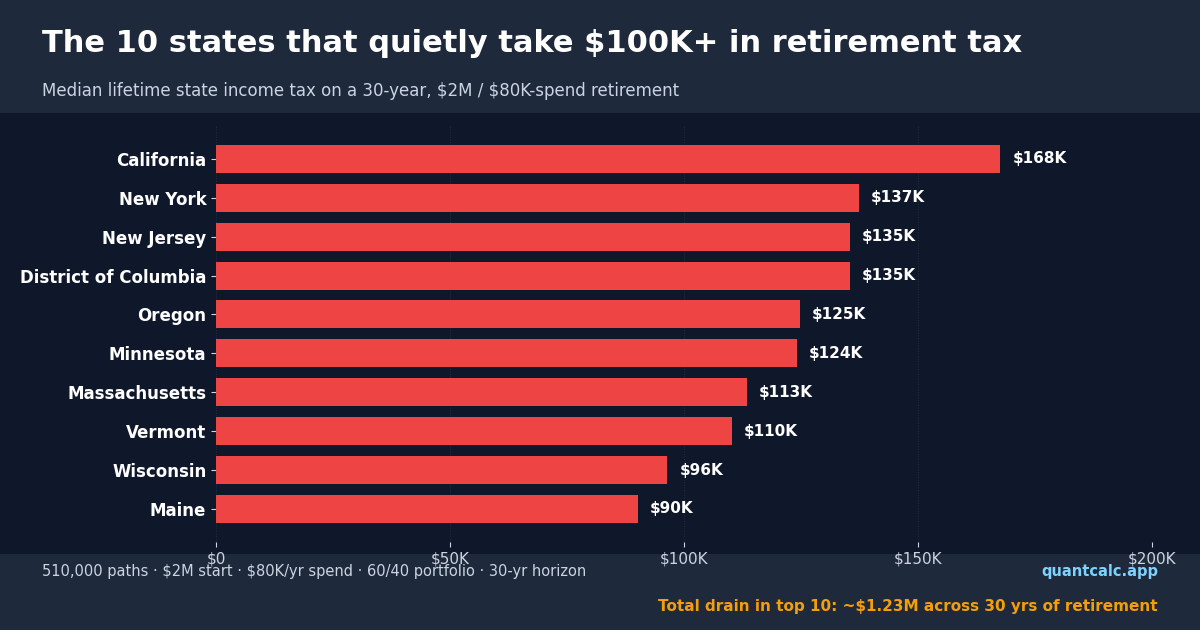
The 10 states that quietly take the most in retirement tax
Median lifetime state income tax on a 30-year, $2M / $80K-spend plan. These ten drain ~$1.25M between them — eight clear $100,000 on their own — against $0 in any of the thirteen jurisdictions that cost this retiree nothing.
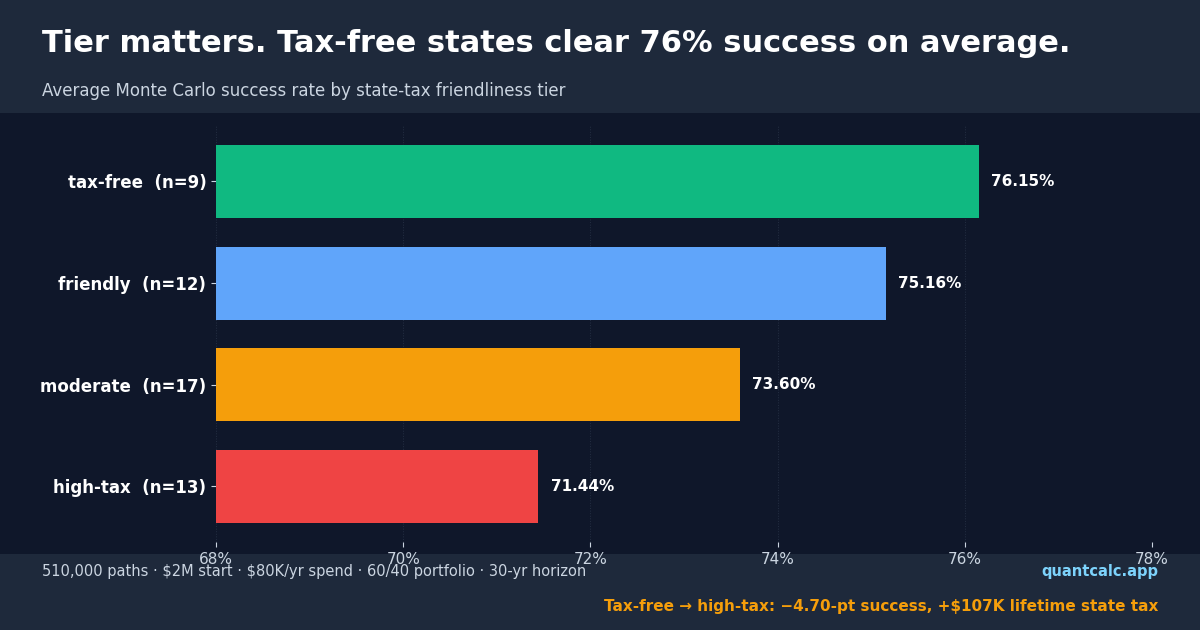
Tier matters: tax-free states average 76% success
Tax-free states beat high-tax states by 4.97 percentage points on average for the same plan, with a $114K lifetime state-tax differential.
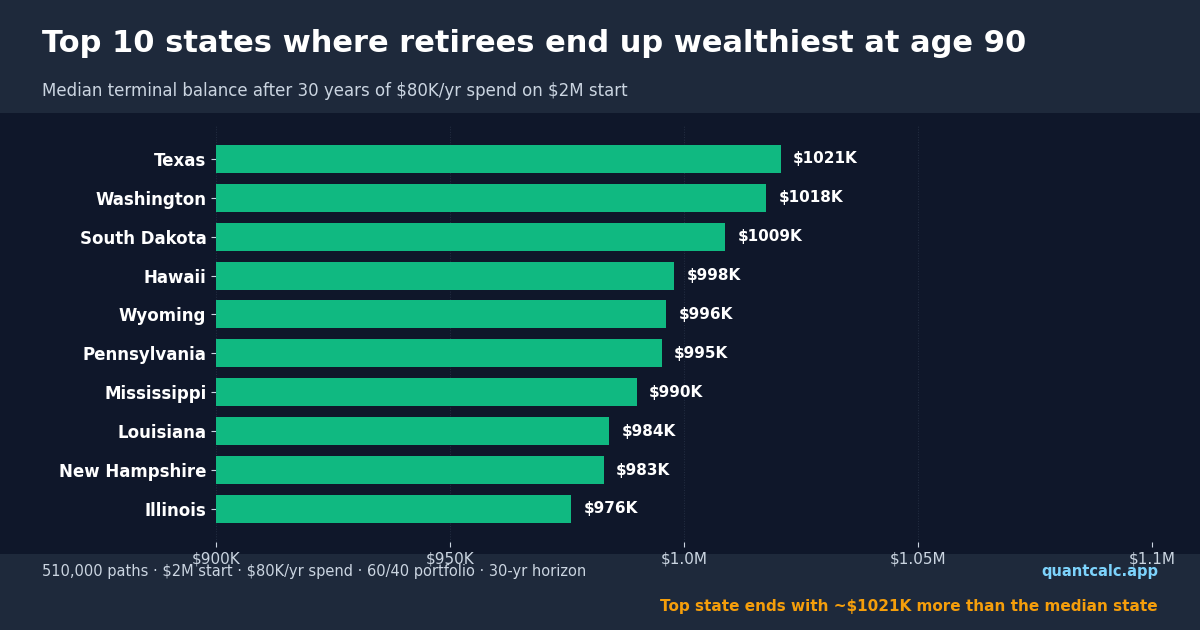
Top 10 states where retirees end up wealthiest at age 90
Median terminal balance after 30 years of $80K spend on $2M start. Same portfolio, same spend — only state-tax exposure differs.
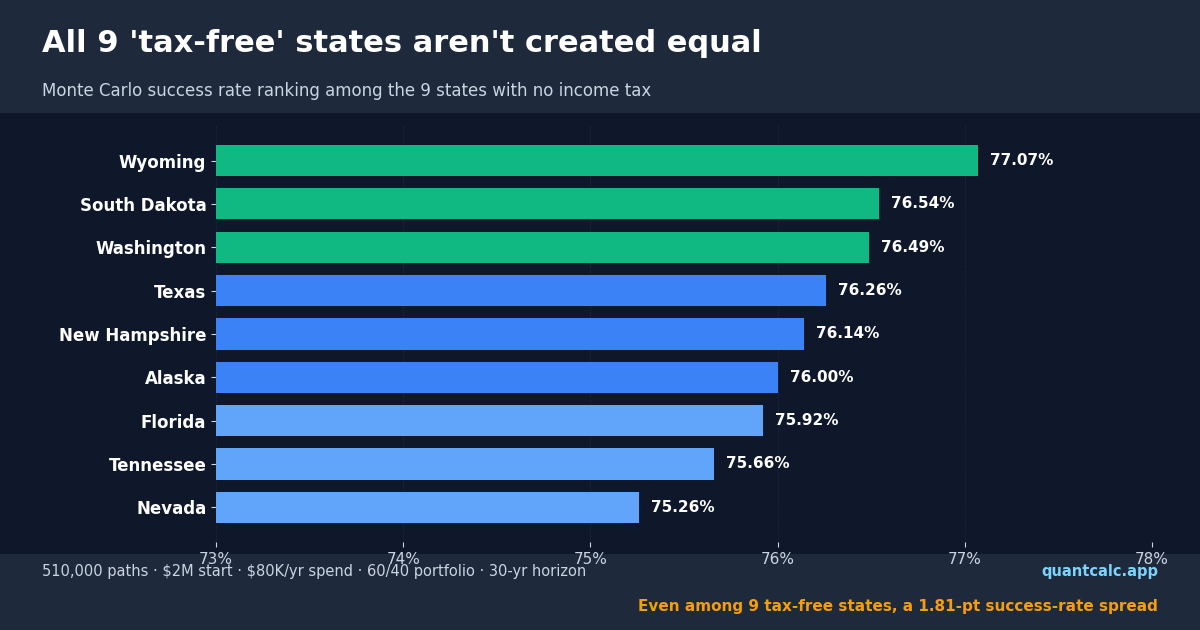
All 9 'tax-free' states aren't created equal
Even among the no-income-tax 9 — where the modelled state-tax bill is identical at $0 — results spread by 1.67 percentage points, which is the sampling noise of a 10,000-path run rather than a real ranking.
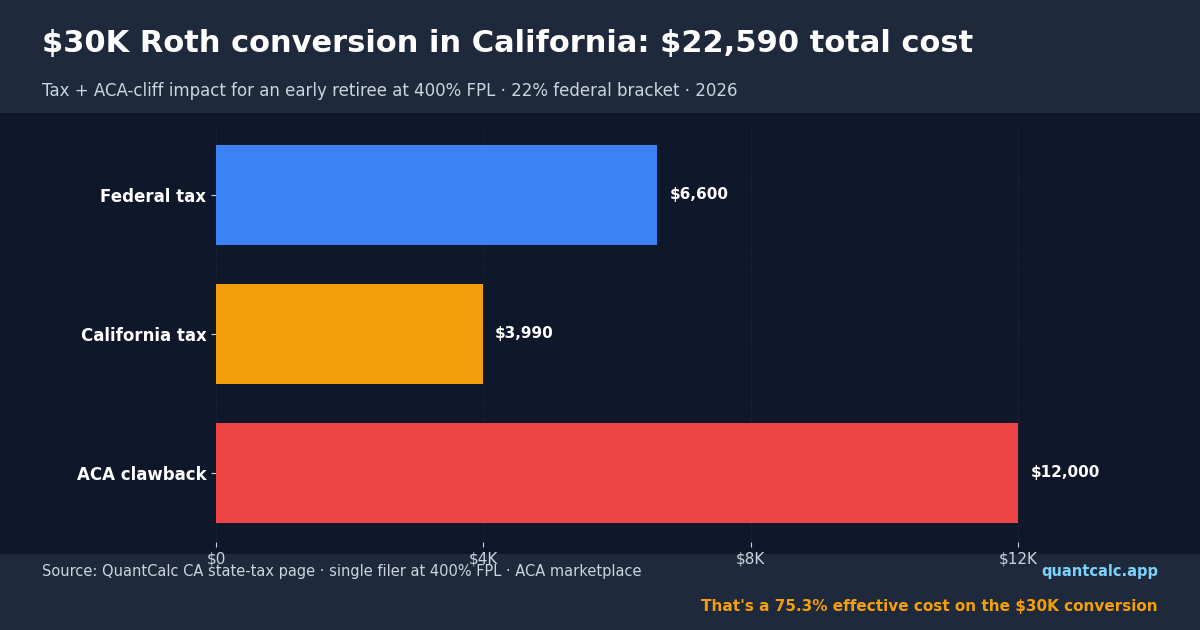
$30K Roth conversion in CA = $22,290 effective cost
Stacked tax + ACA-cliff impact for an early retiree at 400% FPL. The ACA clawback alone is the largest piece — invisible until tax time.
FAQ
What's the best state to retire in for tax purposes?
By our 30-year Monte Carlo: Wyoming (77.11% success rate, $0 state tax), followed by Washington, South Dakota, Pennsylvania and Mississippi. Thirteen jurisdictions cost this retiree $0 in state tax, and they fill the top of the table within about one percentage point of each other — which is inside the simulation's own sampling noise. Choosing among them is about cost-of-living, climate, and family proximity, not tax.
Why is Hawaii near the bottom despite exempting pensions?
Because the exemption does not cover the accounts most retirees actually draw from. Hawaii exempts employer-funded pensions and Social Security, but taxes 401(k) and IRA distributions at a schedule topping out at 11.00% — the second-highest top rate in the country. For a retiree living on IRA withdrawals that comes to $138,600 over 30 years, and 48th place of 51.
Is California really 8 points worse than Wyoming?
For an identical retiree drawing from traditional accounts, yes — across our 30-year simulation. California's bracket schedule tops out at 12.30%, the highest in the country, applies to retirement distributions with no exemption, and compounds against sequence-of-returns risk. A California retiree pays a median $154,980 in state tax over 30 years that a Wyoming retiree does not. The 13.30% figure often quoted for California includes a 1% surcharge that starts above $1,000,000 of income, which this retiree never reaches.
Can I avoid this by moving?
Yes, in principle. Moving residency between states meaningfully shifts retirement tax burden. The catch: state-of-residence rules vary, and a partial-year residency or income-source rules can still subject some income to the former state's tax. Consult a tax professional before changing domicile for tax reasons.
Is this financial advice?
No. This is educational research using a single representative retiree profile. Real retirement outcomes depend on individual portfolio, spending, Social Security timing, healthcare costs, and many factors not modeled here. Use it as one input among many.
Per-state retirement tax guides
Each state in the ranking has a dedicated guide with the same Monte Carlo numbers, plus a tier-specific Roth conversion scenario, a live ACA cliff widget, and a capital-gains interaction paragraph. Direct links:
- Alabama
- Alaska
- Arizona
- Arkansas
- California
- Colorado
- Connecticut
- Delaware
- District of Columbia
- Florida
- Georgia
- Hawaii
- Idaho
- Illinois
- Indiana
- Iowa
- Kansas
- Kentucky
- Louisiana
- Maine
- Maryland
- Massachusetts
- Michigan
- Minnesota
- Mississippi
- Missouri
- Montana
- Nebraska
- Nevada
- New Hampshire
- New Jersey
- New Mexico
- New York
- North Carolina
- North Dakota
- Ohio
- Oklahoma
- Oregon
- Pennsylvania
- Rhode Island
- South Carolina
- South Dakota
- Tennessee
- Texas
- Utah
- Vermont
- Virginia
- Washington
- West Virginia
- Wisconsin
- Wyoming
Related research
Two companion Monte Carlo studies that pair with this one:
- Monte Carlo ACA Cliff 2026: $212k Cost to Early Retirees — 80,000-path study quantifying the cost of the OBBBA-restored 400% FPL cliff for four early-retiree profiles. The state-tax study above does not fold the ACA cliff into the success-rate model; this companion does.
- The 4% Rule Under 6 Forward-Looking Forecasts — does the 4% rule still hold when JPM, BlackRock, Vanguard, GMO, Schwab, and Invesco are publishing lower forward-looking returns (Morningstar's 2026 roundup, checked 2026-09-10)? Full forecast-by-forecast success rates.
Related calculators
- Interactive state tax calculator — single-page comparison across all 51 jurisdictions.
- ACA cliff calculator — the federal threshold modeled in the state-by-state findings above.
- Full QuantCalc methodology — what the production app does that this study omits.
Changelog
- v2026.1 — 2026-05-12, initial release. 510,000 paths across 51 jurisdictions, with each state's tax rate and retirement-income treatment taken from a separately maintained table.
- v2026.2 — 2026-08-23. The per-state tax inputs were corrected and the study re-run from scratch. Rates and retirement-income rules for all 51 jurisdictions are now read from the state-tax engine behind the QuantCalc calculators and its published 2026 dataset, and the rate the study applies is defined as the top of the bracket schedule — the top-of-schedule surcharges California and Massachusetts levy above $1M of income, which this retiree never reaches, are reported alongside it but not applied.
Nineteen jurisdictions had carried an input that differed from the published schedule. What moved:
- Hawaii and Louisiana were treated as exempting 401(k) and IRA withdrawals, and both published $0 in lifetime state tax. Neither exempts them. Hawaii now reads $138,600 over 30 years and ranks 48th of 51 rather than 10th; Louisiana reads $37,800 and ranks 20th rather than 2nd. Both leave the top-10 table, and Hawaii enters the bottom 10.
- Massachusetts was run at 9.00%, its rate including the surcharge above $1,107,750. At the 5.00% bracket rate its 30-year state tax falls from $113,400 to $63,000, and it moves from 45th to 32nd — out of the bottom 10 entirely.
- California falls from $167,580 to $154,980 for the same reason: 12.30% is the bracket schedule, 13.30% adds a 1% surcharge above $1,000,000. It is still 51st.
- South Carolina falls $12,474 to $65,646, and Maryland rises $9,450 to $81,900 — its previous input sat below the schedule, not above it.
- Thirteen more moved by smaller amounts: Arkansas, Georgia, Idaho, Indiana, Kentucky, Montana, Nebraska, North Carolina, Ohio, Oklahoma, Utah and West Virginia, plus Mississippi, whose rate was corrected but which exempts qualified retirement income either way, so its $0 is unchanged.
The spread between the best and worst jurisdiction is now 8.08 percentage points, previously 9.16, and the worst-case 30-year state-tax bill is $154,980, previously $167,580. Every table, chart, download and figure on this page is produced by the corrected run; the CSV and JSON carry it as version 2026.2.
- 2026-09-07 — answer-first summary added at the top of the page (the question, a direct answer, a key-numbers table and matching FAQ structured data). No figure, the CSV or the JSON changed; the dataset remains v2026.2.
Published 2026-05-12; last updated 2026-09-07. Dataset license: CC-BY-4.0. QuantCalc is an independent retirement-planning research project. Not affiliated with, endorsed by, or sponsored by any state or federal agency or any named asset manager. Not financial, tax, or legal advice.