Safe Withdrawal Rate 2026 — 3.3%–3.7% Full Rate Table + Calculator
Research using current forward-looking return expectations puts the safe withdrawal rate near 3.3-3.7% for a 30-year retirement — below the classic 4% rule — and 2.8-3.2% for early retirements of 40+ years. Major institutional forecasts project US large-cap equity returns of 4-7% nominal for the next decade, well under the 10% historical average the 4% rule was built on. Whether 4% is safe depends on your allocation and flexibility. Find your personal rate at quantcalc.app.
| Scenario | 2026 safe withdrawal rate |
|---|---|
| 30-year retirement (fixed spending) | 3.3%–3.7% |
| 40+ year early retirement (FIRE) | 2.8%–3.2% |
| Flexible spending with guardrails | 4.0%–5.0% |
| Classic 4% rule (historical, 1926–1995 data) | 4.0% |
Find your personal 2026 rate in the free calculator →
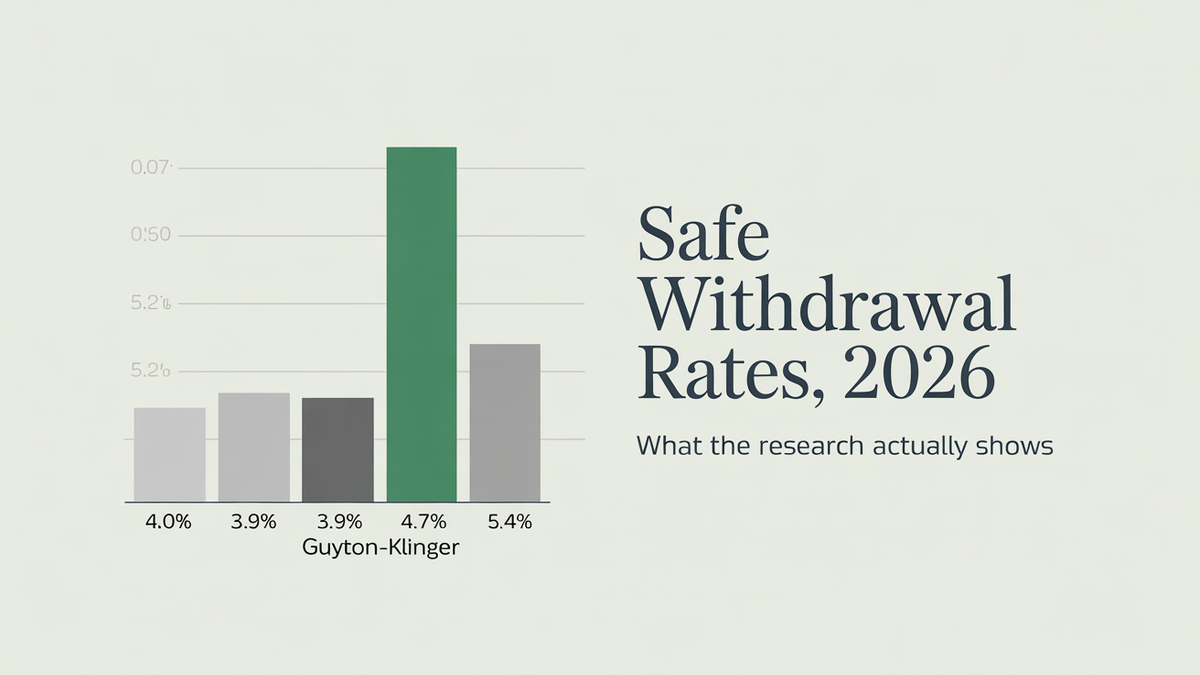
The 4% rule has been the gold standard of retirement planning for decades. But in 2026, with bond yields still recovering, stock valuations near all-time highs, and people living longer than ever, is 4% still safe?
The short answer: It depends—on your asset allocation, spending flexibility, time horizon, and willingness to adjust. This guide breaks down the latest research on safe withdrawal rates and shows you how to find YOUR personal safe rate for today's market environment.
What is a Safe Withdrawal Rate?

Run your own numbers — FREE
10,000 Monte Carlo simulations. Forward-looking forecasts from BlackRock, JPMorgan, Vanguard, GMO, Schwab, Invesco. No account needed.
Try QuantCalc Free →A safe withdrawal rate (SWR) is the percentage of your portfolio you can withdraw in year one of retirement, then adjust for inflation annually, with a high probability (typically 90-95%) that your money will last 30+ years.
The classic 4% rule:
- Start with $1M portfolio
- Withdraw $40k in year 1 (4%)
- Year 2: Withdraw $41,200 (adjusting for 3% inflation)
- Year 3: Withdraw $42,436 (adjusting for inflation again)
- Continue for 30 years
Historical success: Based on US market data from 1926-1995, a 4% withdrawal rate with 50/50 stocks/bonds succeeded in 95% of 30-year periods.
The question in 2026: Does that still hold?
Run your own numbers in the free calculator →
Why Historical Safe Withdrawal Rates Might Not Apply Today
The 4% rule is backward-looking—it tells you what worked historically, not what will work going forward.
Three reasons 4% might be too aggressive in 2026:
1. Lower Bond Yields
- Historical (1926-2000): Bonds yielded 5-7% on average
- 2010s: Yields dropped to 1-3% (near zero during COVID)
- 2026: Yields have recovered to 4-5%, but still below historical average
Impact: Lower bond returns mean lower overall portfolio returns, which reduces sustainable withdrawal rates.
2. High Stock Valuations
- Historically: Stocks traded at P/E ratios of 15-20
- 2026: P/E ratios are 25-30+ (depending on measurement)
Research shows: High starting valuations predict lower future returns. When the CAPE ratio (cyclically adjusted P/E) is above 25, subsequent 10-year stock returns average ~4-6% vs. 10%+ when valuations are low.
Impact: Lower expected stock returns → lower safe withdrawal rates.
3. Longer Lifespans
- A 65-year-old in 1990 had a ~17-year life expectancy
- A 65-year-old in 2026 has a ~20-year life expectancy (and rising)
Impact: 30 years might not be enough for today's retirees. Some need to plan for 35-40 years, which requires lower withdrawal rates.
What Current Research Says About Safe Withdrawal Rates
Multiple recent studies have updated the 4% rule for modern market conditions:
Study 1: Morningstar (2023)
Findings:
- 50/50 stock/bond portfolio: 3.7% withdrawal rate for 90% success over 30 years
- 60/40 portfolio: 3.8%
- 70/30 portfolio: 3.9%
Conclusion: 4% is borderline aggressive. 3.5-3.7% is safer in today's environment.
Study 2: Michael Kitces & Wade Pfau (2024)
Findings: Safe withdrawal rate depends heavily on market valuations at retirement.
- Low CAPE (under 15): 5-6% withdrawal rate is safe (bear markets, cheap valuations)
- Average CAPE (15-25): 4-4.5% is safe
- High CAPE (over 25): 3-3.5% is safe (like 2026)
Conclusion: 2026's high valuations suggest 3.5% is more realistic than 4%.
Study 3: David Blanchett (2023)
Findings: Safe withdrawal rates decline for longer time horizons:
- 30-year retirement: 4.0%
- 35-year retirement: 3.5%
- 40-year retirement: 3.2%
Conclusion: If you're retiring at 55 (vs. 65), you need to withdraw less.
Study 4: Vanguard (2024)
Findings: Dynamic spending strategies (adjusting withdrawals based on market performance) allow starting rates of 5-6% with similar success rates to fixed 4%.
Conclusion: Flexibility is worth 1-2% in withdrawal rate.
(Learn more about dynamic spending strategies)
Safe Withdrawal Rates by Asset Allocation
Your asset allocation is the single biggest driver of your safe withdrawal rate.
| Allocation | 30-Year SWR (90% Success) | Pros | Cons |
|---|---|---|---|
| 100% Stocks | 3.5-4.0% | Highest long-term growth | Extreme volatility, high sequence risk |
| 80/20 Stocks/Bonds | 3.8-4.2% | Strong growth, some stability | Still volatile |
| 60/40 Stocks/Bonds | 3.7-4.0% | Balanced risk/return | Moderate growth |
| 50/50 Stocks/Bonds | 3.5-3.8% | Lower volatility | Lower growth, may not keep up with inflation long-term |
| 30/70 Stocks/Bonds | 3.0-3.3% | Very stable | Insufficient growth for 30+ years |
Key insight: More stocks doesn't always mean higher safe withdrawal rates. Yes, stocks have higher returns—but the higher volatility creates sequence risk that offsets the return advantage.
The sweet spot for most retirees: 50/50 to 70/30 stock/bond allocation.
(Optimize your allocation with modern portfolio theory)
Safe Withdrawal Rates for Early Retirees (FIRE Movement)
If you're retiring at 45 or 50 (financial independence, retire early), standard 30-year safe withdrawal rates are dangerously optimistic.
Adjusted SWRs for early retirement:
- 40-year horizon: 3.2-3.5%
- 50-year horizon: 3.0%
- 60-year horizon: 2.5-2.8%
Why so low? Three compounding factors:
- Longer time horizon = more opportunities for catastrophic market sequences
- You're not earning anything during the longest accumulation years of your life (age 50-65)
- Inflation erodes purchasing power more severely over 50+ years
For FIRE retirees: Either accept a 3% withdrawal rate, build extreme spending flexibility, or plan for part-time income streams.
(Full guide to early retirement planning)
How to Calculate Your Personal Safe Withdrawal Rate
Generic safe withdrawal rates are starting points, not answers. Your personal SWR depends on:
1. Time Horizon
- 20 years: 5-6% might be safe
- 30 years: 3.5-4%
- 40 years: 3-3.5%
- 50 years: 2.5-3%
2. Spending Flexibility
- Rigid spending (fixed costs, no ability to cut): Use conservative SWR (3.5%)
- Moderate flexibility (can cut 10-20% if needed): Middle range (4%)
- Highly flexible (50% discretionary spending): Can sustain 5%+ with dynamic adjustments
3. Other Income Sources
- Social Security, pensions, rental income reduce portfolio dependence
- If half your spending is covered by guaranteed income, you can withdraw more aggressively from the portfolio
Example:
- Total spending: $60k/year
- Social Security: $30k/year
- Portfolio need: $30k/year
- Portfolio size: $600k
- Withdrawal rate: 5% (looks aggressive)
- But: Only half your spending relies on the portfolio, so this is actually quite safe
4. Legacy Goals
- No legacy goal (spend it all): Higher SWR acceptable
- Want to leave $500k+ to heirs: Lower SWR required (you're not spending principal)
5. Risk Tolerance
- High anxiety about running out of money: Use 3-3.5% SWR (oversave)
- Comfortable with some risk: Use 4-4.5% with dynamic adjustments
Dynamic Withdrawal Strategies: The Solution to Low Safe Withdrawal Rates
If 3.5% feels restrictive, there's good news: you don't have to follow a fixed withdrawal rate.
Dynamic strategies adjust withdrawals based on market conditions, allowing you to start at 5-6% and still maintain 90%+ success rates.
Example (Guardrails method):
- Start at 5% withdrawal rate ($50k from $1M)
- If portfolio drops 20%+ in a year: Cut spending 10%
- If portfolio grows 25%+: Increase spending 10%
- Adjust based on market performance
Historical result: 5% initial withdrawal with guardrails succeeds in 90%+ of scenarios—better than fixed 4% rule.
The trade-off: Your spending varies by 10-20% year-to-year. But for retirees with flexibility, this is far better than undershooting spending potential.
(Deep dive on guardrails and dynamic strategies)
Should You Use the 4% Rule in 2026?
Yes, IF:
- You have high spending flexibility (can cut 20%+ if markets crash)
- You're planning a 25-30 year retirement (not 40+)
- You're comfortable with 85-90% success rate (accepting 10-15% ruin risk)
- You'll adjust if markets underperform
No (use 3.5% instead), IF:
- You have fixed costs (mortgage, healthcare) you can't reduce
- You're retiring early (before 60)
- You're highly risk-averse (want 95%+ success probability)
- You have no backup plan (no part-time income option, no home equity, etc.)
The nuanced answer: Start at 4%, but build a plan to cut to 3.5% or 3% if markets crash in the first 5 years. This gives you upside in good scenarios and protection in bad scenarios.
How to Stress-Test Your Withdrawal Rate
Don't rely on historical averages alone. Use Monte Carlo simulation to test YOUR specific situation across thousands of market scenarios.
What to model:
- Your actual portfolio size and allocation
- Your actual spending needs (with vs. without Social Security)
- Your actual time horizon
- Different withdrawal rates (3%, 3.5%, 4%, 4.5%, 5%)
Key outputs:
- Success rate for each withdrawal rate
- Median ending balance (how much you leave behind on average)
- 10th percentile outcome (worst-case scenario)
- Sensitivity to early market crashes
Example findings:
- 3% withdrawal rate: 98% success, median ending balance $2.5M (probably oversaving)
- 4% withdrawal rate: 87% success, median ending balance $800k (acceptable for most)
- 5% withdrawal rate: 68% success, median ending balance $0 (too aggressive unless very flexible)
QuantCalc's Monte Carlo retirement planner runs up to 10,000 simulations to show:
- Your success probability at different withdrawal rates
- How market sequence affects outcomes
- The impact of asset allocation changes
- Dynamic withdrawal strategy performance
You'll see exactly where your risk/reward trade-off is and can choose a withdrawal rate based on YOUR risk tolerance, not generic rules.
The Bottom Line: Your Safe Withdrawal Rate in 2026
For most retirees in 2026:
- Conservative (low risk tolerance): 3.0-3.5% withdrawal rate
- Moderate (average risk tolerance, some flexibility): 3.5-4.0%
- Aggressive (high flexibility, dynamic adjustments): 4.0-5.0% with guardrails
The honest truth: No one knows the future. Markets might deliver 10% returns for the next decade (making 5% safe), or they might deliver 3% (making even 3.5% risky).
The best strategy isn't picking a "perfect" number—it's building flexibility, stress-testing with simulations, and being willing to adjust based on market performance.
Safe withdrawal rates are personal, dynamic, and require ongoing monitoring. But with the right tools and mindset, you can confidently plan a retirement that lasts.
Ready to find your personal safe withdrawal rate? Run a Monte Carlo analysis with QuantCalc and test your retirement across thousands of market scenarios.
Further Reading:
- Retirement Spending Strategies: Beyond the 4% Rule
- What is Monte Carlo Simulation for Retirement Planning?
- Sequence of Returns Risk: What It Is and How to Protect Your Retirement
Frequently Asked Questions
What is a safe withdrawal rate for retirement in 2026?
Research suggests 3.3-3.7% for a 30-year retirement and 2.8-3.2% for a 40+ year early retirement, based on current forward-looking return expectations. The historical 4% rate assumed higher equity returns than most institutions now project. Vanguard (3.5–5.5% nominal), BlackRock (5.2%) and GMO (−6.0% real) all publish US large-cap expectations well below the historical 10% average. Each firm's published assumptions are collected in Morningstar's 2026 roundup, checked 2026-09-10.
How do I determine my personal safe withdrawal rate?
Your safe withdrawal rate depends on your time horizon, asset allocation, tax situation, and flexibility. Run Monte Carlo simulations with your actual portfolio and spending plan. A 90-95% success rate across 10,000 scenarios is the standard target. If your rate falls below 90%, reduce spending, delay retirement, or increase equity allocation to improve the odds.
Frequently Asked Questions
Research suggests 3.3-3.7% for a 30-year retirement and 2.8-3.2% for a 40+ year early retirement, based on current forward-looking return expectations. The historical 4% rate assumed higher equity returns than most institutions now project. Vanguard (3.5–5.5% nominal), BlackRock (5.2%) and GMO (−6.0% real) all publish US large-cap expectations well below the historical 10% average. Each firm's published assumptions are collected in Morningstar's 2026 roundup, checked 2026-09-10.
Your safe withdrawal rate depends on your time horizon, asset allocation, tax situation, and flexibility. Run Monte Carlo simulations with your actual portfolio and spending plan. A 90-95% success rate across 10,000 scenarios is the standard target. If your rate falls below 90%, reduce spending, delay retirement, or increase equity allocation to improve the odds.