USPS Postmark Change: Tax Filers Must Know This 2026
If you're planning to mail your 2025 tax return on April 15, you need to know about a quiet USPS policy change that could cost you hundreds in penalties.
What Changed

Run your own numbers — FREE
10,000 Monte Carlo simulations. Forward-looking forecasts from BlackRock, JPMorgan, Vanguard, GMO, Schwab, Invesco. No account needed.
Try QuantCalc Free →On December 24, 2025, USPS updated how postmarks work. The postmark date now reflects when your envelope is first processed by an automated sorting facility — not when you drop it in the mailbox.
Translation: dropping your tax return in a blue USPS collection box on April 15 no longer guarantees it gets an April 15 postmark.
Run your own numbers in the free calculator →
Why This Matters for Tax Filers
The IRS uses the postmark date — not the date you mailed it — to determine whether your return was filed on time under IRC Section 7502. If your return gets postmarked April 16 because USPS didn't process it until the next day, the IRS considers it late.
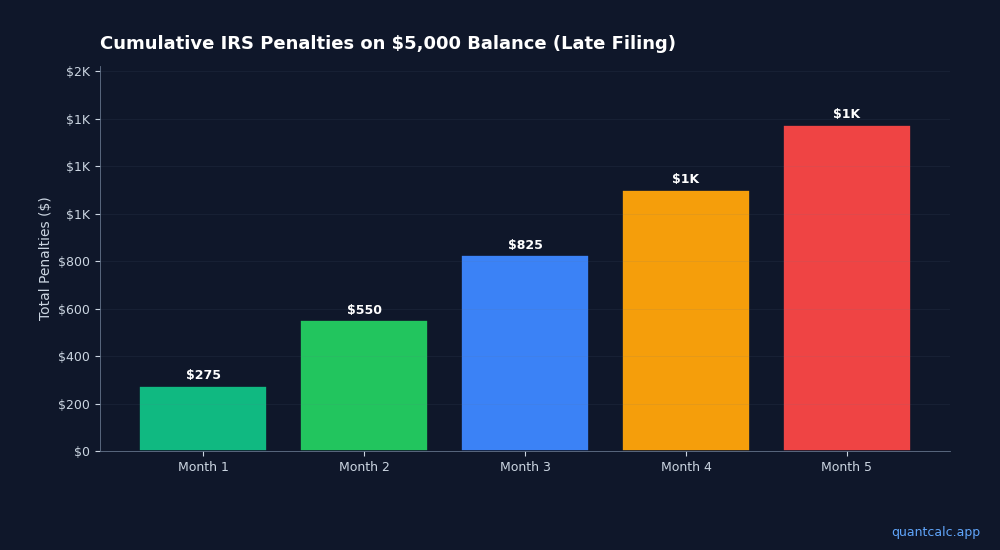
The penalties add up fast:
- Failure to file: 5% of unpaid taxes per month, up to 25%
- Failure to pay: 0.5% of unpaid taxes per month
- Combined: 5% per month on what you owe for the first five months, because the failure to file penalty is reduced by the amount of the failure to pay penalty when both apply
On a $5,000 balance, that's $250 (plus interest) for one month of "late" filing — because USPS didn't postmark your envelope the same day you mailed it.
Who's at Risk
This affects anyone still mailing paper returns, estimated tax payments (Form 1040-ES), extension requests (Form 4868), or any time-sensitive IRS correspondence. The IRS received approximately 14 million paper returns through mid-March 2026. Every one of those filers faces this risk if they wait until April 15.
This is especially relevant for:
- Freelancers and self-employed filers mailing estimated tax payments
- Taxpayers in rural areas where collection boxes may be processed at distant sorting facilities
- Anyone mailing on the deadline rather than days in advance
How to Protect Yourself
Option 1: File Electronically (Safest)
E-filed returns get an instant timestamp. No postmark ambiguity. If you can e-file, do it. The IRS Free File program's guided software covers taxpayers with AGI of $89,000 or less.
Option 2: Visit a Post Office Counter
Request a hand-cancelled (manual) postmark at the retail counter. This is how you make sure the postmark matches the date you mailed. The clerk stamps it in front of you. USPS states that customers may request a manual postmark at a retail counter.
Option 3: Use Certified Mail
USPS Certified Mail provides proof of mailing date and tracking. The certified mail receipt serves as evidence of timely mailing regardless of when the postmark is applied. Cost: $5.55 per item plus postage (USPS fee as of September 2026).
Option 4: Mail Early
If you must use a collection box, mail your return at least 2-3 business days before the deadline. This gives USPS time to process and postmark it before April 15.
What About Estimated Tax Payments?
The same risk applies to your Q1 2026 estimated tax payment (also due April 15). If you're self-employed or have income without withholding, consider:
- Paying online via IRS Direct Pay — free, instant confirmation
- Using EFTPS for scheduled payments
- Using our Freelancer Tax Estimator Chrome extension to calculate exactly what you owe before paying
The Bigger Picture
This USPS change has been covered by Wolters Kluwer, Wipfli, AARP, Brookings, and Creative Planning — but most taxpayers still don't know about it. The change happened quietly on Christmas Eve 2025 with minimal public notice.
If you have clients, friends, or family members who still mail their returns, share this with them now. Eleven days is enough time to adjust — but only if they know.
Planning Your Tax Strategy
Beyond the mailing logistics, make sure your actual tax numbers are right. If you're an early retiree managing ACA subsidies and the 400% FPL cliff, or a freelancer calculating quarterly estimated payments, small errors compound into real money.
Use QuantCalc to run Monte Carlo simulations on your retirement plan with tax-aware withdrawal sequencing — or try our free tax calculator extensions for quick estimates.
Sources: Wolters Kluwer, Wipfli, AARP, Brookings, Avalara, Creative Planning