Bucket Strategy for Retirement: 3 Buckets to Weather Any Market
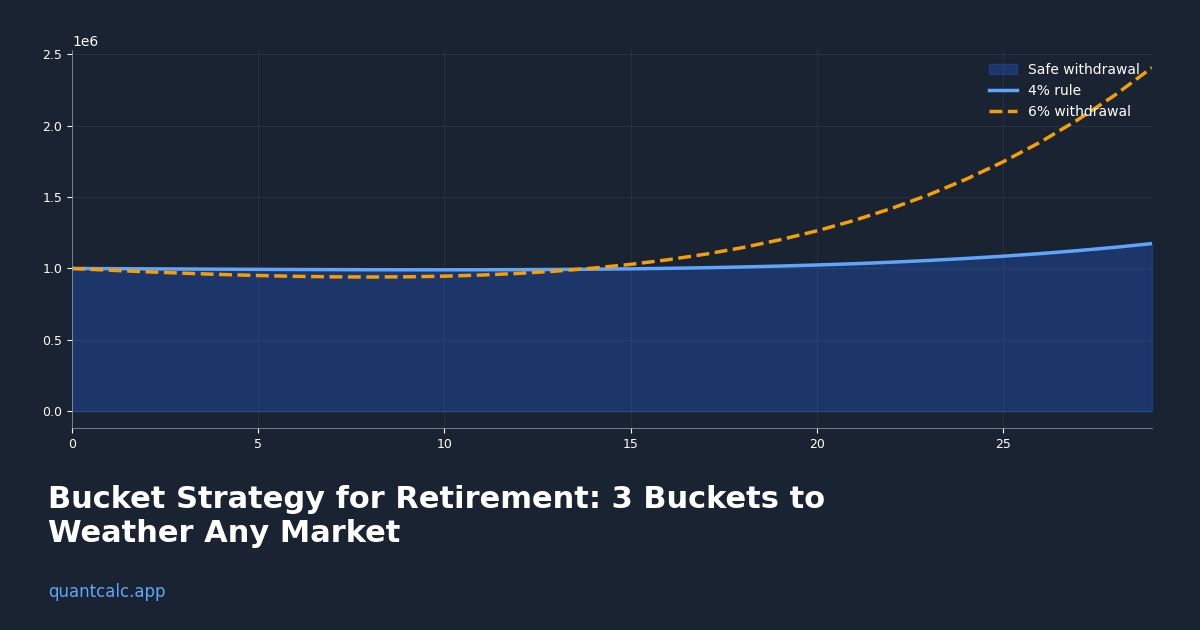
Size your three buckets
Bucket 1 (cash) and Bucket 2 (bonds) hold a set number of years of spending; Bucket 3 (growth) is whatever's left.
PRO models refilling the buckets and rebalancing across 10,000 market paths, so you can see how often Bucket 1 runs dry. Unlock it in the app →
Most retirement portfolios are managed as a single pool—60% stocks, 40% bonds, rebalance annually, hope for the best. But what if you're three years into retirement and stocks crash 40%? Suddenly you're forced to sell stocks at the bottom to cover living expenses.
Enter the bucket strategy: divide your portfolio into time-based segments, each with different asset allocations and purposes. Bucket 1 covers years 1-5 (cash/bonds), Bucket 2 covers years 6-15 (balanced), Bucket 3 covers years 16+ (aggressive growth).
This guide shows you exactly how to build a bucket strategy, when it makes sense, and whether it's actually better than a simple rebalanced portfolio (spoiler: the math says no, but the psychology says maybe).
What Is the Bucket Strategy?

Run your own numbers — FREE
10,000 Monte Carlo simulations. Forward-looking forecasts from BlackRock, JPMorgan, Vanguard, GMO, Schwab, Invesco. No account needed.
Try QuantCalc Free →The bucket strategy divides your retirement portfolio into three separate "buckets" based on when you'll need the money:
Bucket 1: Short-term (Years 1-5)
- Purpose: Fund living expenses for the next 5 years
- Allocation: 100% cash and short-term bonds (ultra-safe, no volatility)
- Amount: 5 years of expenses (e.g., $200k if spending $40k/year)
Bucket 2: Medium-term (Years 6-15)
- Purpose: Refill Bucket 1 after good market years
- Allocation: 50/50 stocks/bonds (balanced)
- Amount: 10 years of expenses ($400k)
Bucket 3: Long-term (Years 16+)
- Purpose: Growth for longevity, don't touch unless emergency
- Allocation: 80/20 or 70/30 stocks/bonds (aggressive)
- Amount: Remaining assets ($400k+)
Total example portfolio: $1M split into three buckets
Run your own numbers in the free calculator →
How the Bucket Strategy Works in Practice
Year 1: Spend from Bucket 1
- Withdraw $40k from Bucket 1 (cash/bonds)
- Don't touch Buckets 2 or 3
- Let Buckets 2 and 3 grow
Year 2: Good market year (stocks up 20%)
- Spend $40k from Bucket 1
- Refill Bucket 1: Sell $40k from Bucket 3 (stocks), move to Bucket 1
- Bucket 2 grows
- Bucket 3 shrinks slightly but still growing
Year 3: Bad market year (stocks down 30%)
- Spend $40k from Bucket 1
- Do NOT refill Bucket 1 (don't sell stocks at a loss)
- Let Buckets 2 and 3 recover
Years 4-5: Market recovers
- Continue spending from Bucket 1
- Once Bucket 3 has recovered, refill Bucket 1
The key rule: Only refill Bucket 1 after good market years. Never sell stocks during crashes.
The Psychology: Why the Bucket Strategy Feels Good
The bucket strategy is psychologically powerful, even if mathematically equivalent to a rebalanced portfolio.
What it provides:
1. Visible Safety
You can "see" 5 years of expenses sitting safely in cash/bonds. This is emotionally reassuring during market crashes.
Contrast with single-portfolio approach:
- 60/40 portfolio crashes 24% (60% stocks × -40% + 40% bonds × 0%)
- You're selling from a declining portfolio → Feels terrible
2. Prevents Panic Selling
Scenario: March 2020, stocks crash 35% in 3 weeks.
- Single portfolio approach: "My portfolio is down $300k! Should I sell before it gets worse?"
- Bucket approach: "Bucket 1 has 5 years of cash. I don't need to touch stocks for years. Let it recover."
The bucket strategy enforces discipline by design.
3. Clear Decision Rules
- Stocks up 20%? Refill Bucket 1.
- Stocks down 30%? Do nothing, live off Bucket 1.
No guesswork, no emotional decisions.
The Math: Is the Bucket Strategy Actually Better?
Short answer: No. It's mathematically equivalent to a balanced portfolio with systematic rebalancing.
Here's why:
Bucketing Is Just Asset Location
Bucket strategy:
- Bucket 1: $200k cash
- Bucket 2: $400k (50/50)
- Bucket 3: $400k (80/20)
Total allocation: ~55% stocks, 45% bonds (averaged across all buckets)
Single portfolio approach:
- $1M at 55/45 allocation
Mathematically, these are identical. The only difference is labeling and mental accounting.
Research Shows Minimal Performance Difference
What research on bucket strategies generally finds:
- Bucket strategies and rebalanced portfolios have nearly identical long-term returns
- Bucket strategies sometimes have slightly LOWER returns (due to cash drag in Bucket 1)
- Success rates (probability of not running out of money) are the same
Why use buckets then? Behavioral benefit. If it helps you stick to your plan during crashes, it's worth it.
You can test this equivalence yourself: model your 3-bucket plan as its blended overall allocation and compare success rates across thousands of simulated market paths.
(Learn more about rebalancing strategies)
How to Set Up a Bucket Strategy
Step 1: Calculate Your Annual Expenses
- Fixed expenses: Housing, insurance, utilities, food
- Discretionary: Travel, hobbies, dining out
- Total: e.g., $50,000/year
Step 2: Determine Bucket Sizes
Bucket 1 (Cash):
- 5 years of expenses (conservative) OR 3 years (moderate)
- Example: 5 × $50k = $250k
Bucket 2 (Balanced):
- 10 years of expenses
- Example: 10 × $50k = $500k
Bucket 3 (Growth):
- Remaining portfolio
- Example: $1.2M total - $250k - $500k = $450k
Step 3: Set Allocations
Bucket 1:
- 100% cash, money market, short-term bonds (1-2 year duration)
- Goal: Zero volatility
Bucket 2:
- 40-60% stocks, 40-60% bonds
- Example: 50/50
Bucket 3:
- 70-80% stocks, 20-30% bonds
- Example: 75/25
Step 4: Choose Specific Investments
Bucket 1:
- High-yield savings (4-5% as of 2026)
- Money market funds (VMMXX, SPAXX)
- Short-term bond ETF (SHV, VGSH)
Bucket 2:
- Balanced fund (VBAIX, Vanguard Balanced Index)
- OR: 50% VTI (total stock) + 50% BND (total bond)
Bucket 3:
- Stock-heavy fund (VTSAX, VTI)
- OR: 75% VTI + 25% BND
Step 5: Implement the Refill Rules
Annual review (January):
- Check Bucket 1 balance (how many years of expenses left?)
- Check Bucket 3 performance (up or down?)
- If Bucket 3 is up 10%+ AND Bucket 1 has <5 years: Refill Bucket 1
- If Bucket 3 is down: Do nothing, leave Bucket 1 alone
Spending:
- Withdraw from Bucket 1 monthly or quarterly
- Ignore Buckets 2 and 3 unless refilling
Modified Bucket Strategies
Two-Bucket Approach (Simpler)
Bucket 1: 5 years cash/bonds
Bucket 2: Everything else (70/30 stocks/bonds)
Pros: Simpler, fewer decisions
Cons: Less granular control
Four-Bucket Approach (More Complex)
Bucket 1: Years 1-3 (cash)
Bucket 2: Years 4-10 (bonds)
Bucket 3: Years 11-20 (balanced)
Bucket 4: Years 21+ (aggressive)
Pros: Even more tailored
Cons: Overkill for most retirees
Dynamic Bucket Sizing
Adjust bucket sizes based on market valuations:
- When stocks are expensive (P/E >25): Keep Bucket 1 larger (7 years)
- When stocks are cheap (P/E <15): Shrink Bucket 1 (3 years)
Why it works: You're giving yourself more time to wait out crashes when valuations are high (crashes more likely).
Bucket Strategy vs. Traditional Portfolio
| Feature | Bucket Strategy | Single Portfolio (60/40) |
|---|---|---|
| Complexity | Moderate (3 accounts) | Simple (1 account) |
| Rebalancing | Rule-based (refill after gains) | Calendar-based (annual) |
| Psychological comfort | High (visible 5-year safety) | Moderate |
| Returns | Slightly lower (cash drag) | Slightly higher |
| Sequence risk protection | Good (Bucket 1 shields from forced selling) | Moderate |
| Withdrawal strategy | Automated (always from Bucket 1) | Manual (sell proportionally or tax-optimize) |
| Tax efficiency | Harder (multiple accounts to track) | Easier |
Verdict: Bucket strategy is slightly more work, slightly lower returns, but psychologically easier for some retirees.
When the Bucket Strategy Makes Sense
Good fit for:
- Investors who find market crashes hard to sit through
- Retirees with fixed expenses (need to know 5 years is "safe")
- People who want simple rules ("spend from Bucket 1, refill after gains")
- Early retirees (40-60 year horizon, need to protect against early sequence risk)
Not necessary for:
- Disciplined investors who can stick to a rebalancing plan during crashes
- Retirees with pensions/Social Security covering most expenses (portfolio is "extra")
- Those who prioritize tax efficiency (bucket strategy complicates tax-loss harvesting and asset location)
Common Bucket Strategy Mistakes
Mistake 1: Making Bucket 1 Too Large
If Bucket 1 is 10 years of expenses (100% cash), you're sacrificing $200-400k+ in long-term growth.
Optimal: 3-5 years max. Any more is unnecessary safety that costs returns.
Mistake 2: Never Refilling Bucket 1
If you follow the "only refill after gains" rule too strictly, you might never refill (especially during prolonged bear markets).
Solution: Set a minimum threshold. If Bucket 1 drops below 2 years, refill from Bucket 2 even if markets are down.
Mistake 3: Ignoring Taxes
Selling from Bucket 3 to refill Bucket 1 can trigger capital gains taxes.
Solution: Hold Bucket 3 in IRAs (tax-deferred accounts) or use tax-loss harvesting.
Mistake 4: Forgetting About Inflation
Bucket 1 in cash erodes 3%/year due to inflation. If you never refill it, purchasing power drops.
Solution: Refill Bucket 1 regularly (every 2-3 years after gains) to restore purchasing power.
Mistake 5: Over-Complicating With Too Many Buckets
Four or five buckets sound sophisticated but are a pain to manage.
Best practice: Stick with 2-3 buckets max.
Real-World Example: Bucket Strategy in Action
Meet George, age 65, $1.2M portfolio, $60k/year spending:
Setup:
- Bucket 1: $300k (5 years × $60k) in high-yield savings + short-term bonds
- Bucket 2: $450k (50/50 stocks/bonds)
- Bucket 3: $450k (75/25 stocks/bonds)
Year 1-2 (bull market):
- Spend $60k/year from Bucket 1 → Now $180k
- Bucket 3 grows to $540k (+20%)
- Action: Sell $120k from Bucket 3, refill Bucket 1 to $300k
Year 3 (crash, stocks down 35%):
- Spend $60k from Bucket 1 → Now $240k
- Bucket 3 drops to $300k
- Action: Do NOTHING. Bucket 1 still has 4 years left.
Year 4-5 (recovery):
- Spend $60k/year → Bucket 1 now $120k (2 years left)
- Bucket 3 recovers to $450k
- Action: Refill Bucket 1 to $300k
Result over 10 years:
- George never sold stocks during the crash (avoided locking in losses)
- He refilled Bucket 1 four times (every 2-3 years after gains)
- Portfolio grew from $1.2M to $1.8M despite $600k in withdrawals
- He slept well during the crash because Bucket 1 had 4 years of safety
Compare to single-portfolio approach:
- Same returns, same success rate
- BUT: George's psychological comfort was higher with buckets
How to Implement a Bucket Strategy Today
Option 1: DIY (Most Control)
- Open separate accounts at your brokerage for each bucket
- Label them: "Bucket 1 Cash," "Bucket 2 Balanced," "Bucket 3 Growth"
- Set calendar reminders to review annually
Option 2: Robo-Advisor
- Betterment and Wealthfront describe investing organised around goals — Betterment: “investment portfolios for each goal”; Wealthfront: “Customize to your goals and risk level” (as published on betterment.com and wealthfront.com, checked 2026-09-07)
- Betterment’s site describes “trading, rebalancing, and tax management done for you”; Wealthfront’s pricing page states “We’ll balance your funds as the market moves”
- Cost: see the vendor’s pricing page (Betterment, Wealthfront)
Option 3: Financial Advisor
- Some advisors implement bucket strategies for clients
- They'll handle refilling, rebalancing, tax optimization
- Cost: advisory fees vary — ask for the fee schedule
Option 4: Target-Date Funds (Simplified Bucket)
- Hold a mix of target-date funds with different years
- Example: 20% in 2025 fund (near-cash), 30% in 2035 fund, 50% in 2055 fund
- Pros: Automatic glide path
- Cons: Less control; check each fund’s expense ratio
The Bottom Line: Buckets Are for Psychology, Not Performance
The bucket strategy won't make you richer—it's mathematically equivalent to a balanced, rebalanced portfolio.
But if it helps you:
- Sleep better during market crashes
- Avoid panic selling
- Stick to your long-term plan
...then it's worth the slight extra complexity.
Best for: Retirees who need to "see" safe money to stay disciplined during volatility.
Skip it if: You're comfortable with traditional rebalancing and can ignore market noise.
The hybrid approach: Keep 2-3 years of expenses in cash (mini Bucket 1) and invest the rest in a 60/40 or 70/30 portfolio. Best of both worlds—some psychological safety without overdoing the cash drag.
Ready to test whether a bucket strategy improves your retirement success? Model both approaches with QuantCalc and compare outcomes across thousands of market scenarios.
Further Reading:
- Retirement Spending Strategies: Beyond the 4% Rule
- Retirement Portfolio Rebalancing: When and How to Do It
- Retirement Asset Allocation by Age: The Glide Path Strategy
Frequently Asked Questions
The bucket strategy divides your retirement portfolio into three separate "buckets" based on when you'll need the money:
Short answer: No. It's mathematically equivalent to a balanced portfolio with systematic rebalancing.