When does tax-loss harvesting actually pay?
78.4% of scenarios pay — the rest don't. In 78.4% of the 768 scenarios in this grid — and reliably in two situations: when the future tax never comes due (the replacement shares get a step-up at death or are donated, where every positive harvest pays), and when a high-rate loss offsets low-rate future gains. It loses whenever the offset gains sat in the 0% long-term bracket (nothing saved now, basis lowered anyway: NPV as low as −$1,865 on a $10,000 loss) and when rates will be higher at the future sale (saving at 15% today, selling in five years at 23.8%: −$365). Which gains the loss offsets matters more than timing: at the top income level a short-term offset saved $4,080 against $2,380 for a long-term one — 1.71× — while pure deferral at the same rate is worth $579 on $10,000 for a middle-income filer at 10 years. Federal only, 2026 law, 5% discount rate, published 2026-07-02 — see Result 1, Result 2 and Result 3.
Key numbers — each row links to the section that carries the full table. Updated 2026-09-07; data unchanged.
| Key number | Value | Where on this page |
|---|---|---|
| Scenarios where harvesting a $10,000 loss has a positive NPV | 78.4% of 768 | The grid |
| Worst NPV in the 0%-bracket trap (nothing saved now, basis lowered) | −$1,865 | Result 1 |
| Tax saved now at the top income level: short-term offset vs long-term offset | $4,080 vs $2,380 (1.71×) | Result 2 |
| Reverse rate arbitrage: save at 15% now, sell at 23.8% in five years | −$365 | Result 3 |
| Pure deferral value, same rate later, middle income, 10-year horizon | $579 | Result 1 |
| Step-up / donation scenarios with positive savings that pay | 100% | Result 3 |
| Grid size and discount rate | 768 scenarios, 5% | Methodology |
The question
Every December, investors are told to "harvest losses." The advice usually stops at the tax saved this year. But harvesting resets your cost basis lower: the tax you avoid today largely comes back as a bigger taxable gain later. Whether the trade is worth it is a net-present-value question — savings now versus a discounted tax bill later. We computed it, exhaustively.
The grid
A $10,000 harvested loss, run through 768 scenarios: 2 filing statuses × 4 income regimes (from the 0% long-term bracket to 20% + NIIT) × 2 loss characters (short/long-term) × 3 offset contexts (long-term gains, short-term gains, or no gains — the $3,000-per-year ordinary path) × 4 future-rate scenarios (step-up/donation, same rate, 18.8%, 23.8%) × 4 horizons (5–30 years), at a 5% discount rate. Savings are exact engine differences — full Schedule D netting, LTCG stacking, NIIT on true MAGI — never marginal-rate shortcuts.
Result 1: what a $10,000 harvest is worth by income
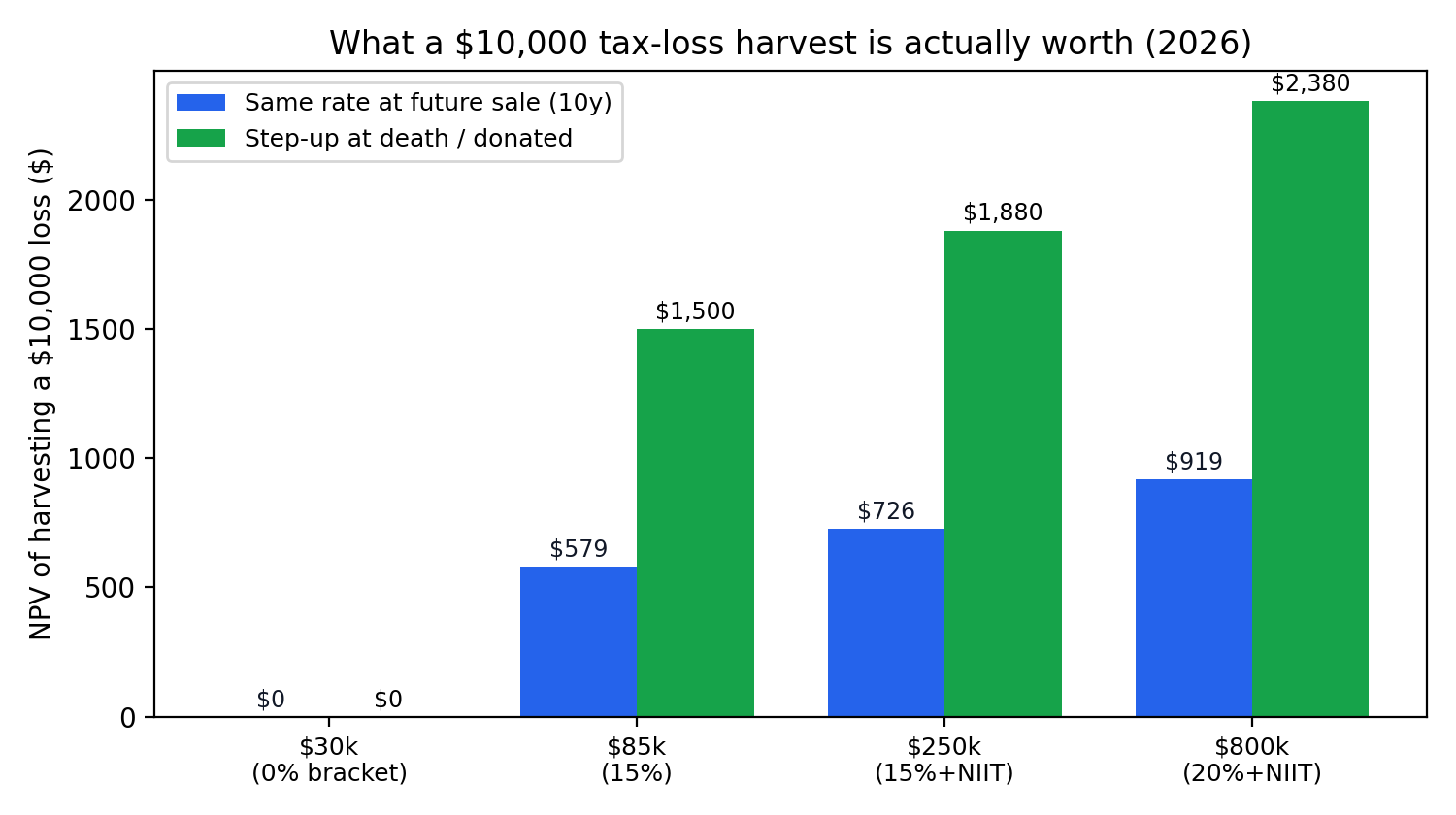
| Income regime (single) | Saved now | NPV, same rate later (10y) | NPV, step-up/donate | NPV, no-gains $3k path (10y) |
|---|---|---|---|---|
| Low (0% LTCG bracket) $30,000 ordinary income | $0 | $0 | $0 | $1,047 |
| Middle (15% bracket) $85,000 ordinary income | $1,500 | $579 | $1,500 | $2,077 |
| High (15% + NIIT) $250,000 ordinary income | $1,880 | $726 | $1,880 | $3,021 |
| Top (20% + NIIT) $800,000 ordinary income | $2,380 | $919 | $2,380 | $3,494 |
Result 2: character is worth more than timing
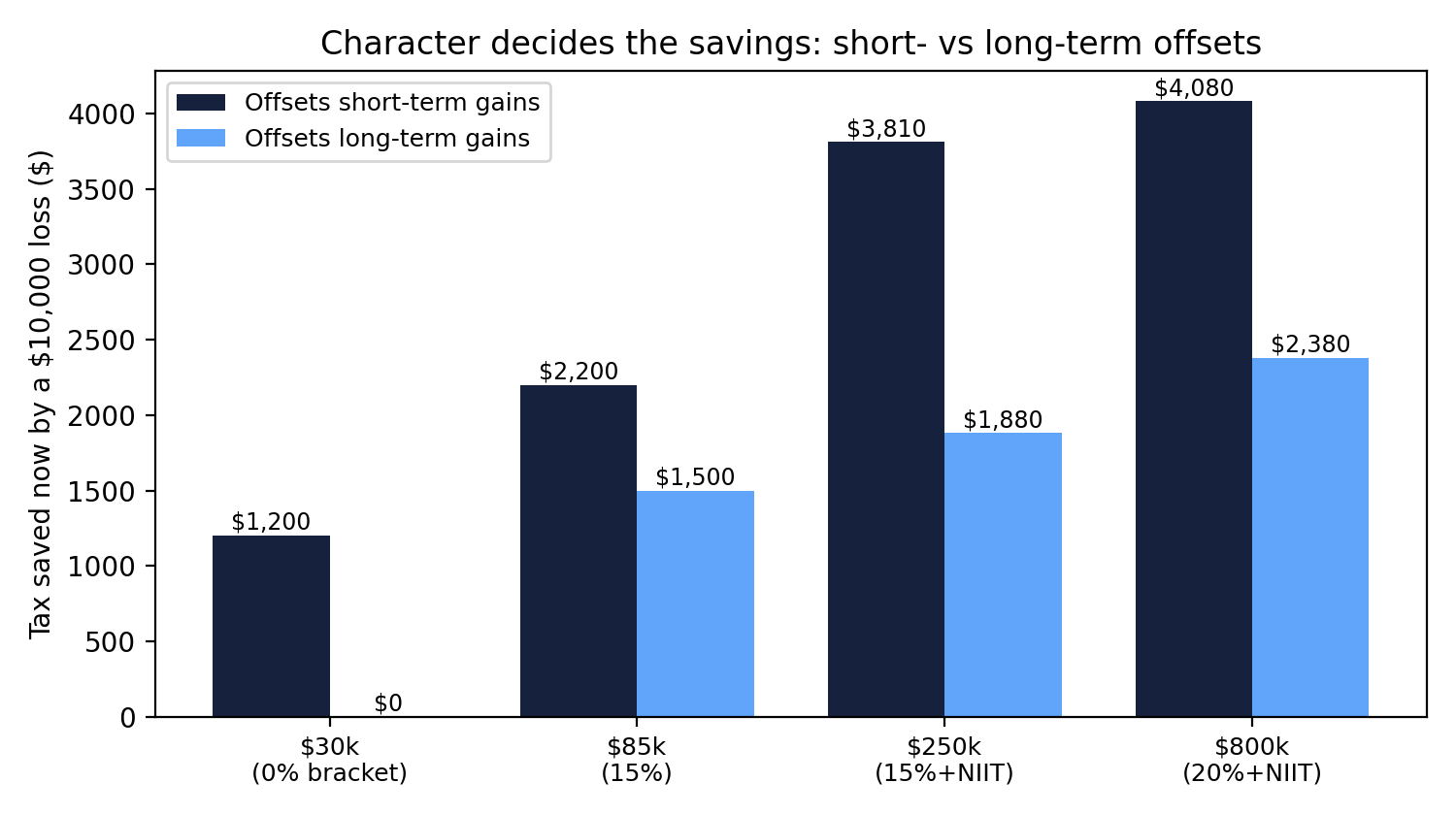
A loss that offsets short-term gains (taxed as ordinary income) saves far more than the same loss offsetting long-term gains: $4,080 versus $2,380 at the top income level — 1.71× the savings from the identical $10,000 loss. Schedule D's netting order decides this before you do: same-character gains absorb the loss first, so which lots you realize in the same year is the biggest lever in the whole study.
Result 3: when harvesting loses money
- 0%-bracket offsets: nothing saved, basis lowered — NPV as low as −$1,865.
- Reverse rate arbitrage: save at 15% today, sell in five years at 23.8% — NPV −$365. (A smaller jump, 18.8% → 23.8% over five years, is roughly breakeven at a 5% discount — the sign flips with the rate gap and the horizon.)
- Wash sales: not modeled in the grid because the outcome is trivial — the loss is disallowed and the harvest accomplishes nothing. The calculator checks the 61-day window for you.
Conversely, with a step-up at death or a donation of the replacement shares, the future bill never arrives — every dollar of current savings is pure gain, and 100% of positive-savings step-up scenarios in the grid pay.
Run your own harvest before you sell
The free calculator computes your exact netting, savings, NPV and break-even — the same tested engine as this study.
Open the harvesting calculator →Methodology
All computations use the open 2026 federal engine behind our calculator (133-assertion unit suite, cross-checked to ±$0.01 against an independent C implementation): Schedule D netting with character-preserving carryforward (§1211/§1212), long-term gains stacked on ordinary income (§1(h)), NIIT on true MAGI (§1411), 2026 figures per IRS Rev. Proc. 2025-32. "Saved now" is the exact difference between the year's total tax with and without the harvested loss; the no-gains context discounts each year of the $3,000-per-year carryforward consumption. The future cost is the harvested amount times the expected all-in rate at the future sale, discounted at 5%. Federal only — state layers shift levels but rarely signs; reinvested-savings compounding is not modeled (this understates harvesting benefits slightly, making the negative findings conservative).
Reproducibility
The full 768-cell grid is open data (CC0): results.csv · summary.json. The engine itself ships unminified at /js/calc/capital-gains-tlh-2026.js; the grid is a pure deterministic function of it (no randomness, no seed).
FAQ
When does tax-loss harvesting actually pay?
In 78.4% of the 768 scenarios in this grid — and reliably in two situations: when the future tax never comes due (the replacement shares get a step-up at death or are donated, where every positive harvest pays), and when a high-rate loss offsets low-rate future gains. It loses whenever the offset gains sat in the 0% long-term bracket (nothing saved now, basis lowered anyway: NPV as low as −$1,865 on a $10,000 loss) and when rates will be higher at the future sale (saving at 15% today, selling in five years at 23.8%: −$365). Which gains the loss offsets matters more than timing: at the top income level a short-term offset saved $4,080 against $2,380 for a long-term one — 1.71× — while pure deferral at the same rate is worth $579 on $10,000 for a middle-income filer at 10 years. Federal only, 2026 law, 5% discount rate, published 2026-07-02 — see Result 1, Result 2 and Result 3.
Does tax-loss harvesting always save money?
No. Across the 768 scenarios in this study, harvesting a $10,000 loss produced a positive net present value in 78.4% of cases. The clearest losing case is harvesting when your gains sit in the 0% long-term bracket: the harvest saves nothing today, but the lowered basis creates a real future tax bill — up to −$1,865 NPV on a $10,000 loss in our grid.
When is harvesting a clear win?
Two situations dominate: (1) the replacement shares will get a step-up in basis at death or be donated — the deferred cost never comes due, so every dollar of current savings is pure gain; and (2) the loss offsets short-term gains or ordinary income at a high marginal rate while the future sale will be taxed at long-term rates — a rate arbitrage. At the top income level in our grid, a short-term offset saved $4,080 versus $2,380 for a long-term offset — 1.71× more, on the same $10,000 loss.
Can harvesting actually lose money?
Yes, two ways. Harvesting gains that would have been taxed at 0% (nothing saved now, higher tax later), and rate arbitrage in reverse: saving at today's 15% rate but selling within five years at 23.8% produced an NPV of −$365 in our grid. A wash-sale violation is a third way — the loss is simply disallowed.
What about the $3,000-per-year path with no gains to offset?
A $10,000 loss with no gains offsets ordinary income at $3,000 per year ($1,500 married filing separately) and carries forward. The savings arrive over four years instead of one, so they are worth slightly less after discounting — but at ordinary-income marginal rates they are often still the strongest per-dollar savings available at middle and high incomes.
Why does the time horizon matter?
The cost of harvesting is a larger taxable gain later (the replacement basis is lower by the harvested amount). The further away that sale is, the less it costs in present value: at a 5% discount rate the same future tax bill costs 22% less at 10 years than at 5, and 77% less at 30 years. Long horizons push most same-rate scenarios to a positive NPV of pure deferral value — for example $579 on $10,000 for a middle-income filer at 10 years.
How were these numbers computed?
Every scenario runs through the same open, unit-tested 2026 federal tax engine as our free calculator: full Schedule D netting, the LTCG stacking method, NIIT on true MAGI, and character-preserving carryforward, per IRS Rev. Proc. 2025-32 figures. Savings are computed as exact with-versus-without engine differences, never marginal-rate shortcuts. The full grid is published as CC0 open data below.
Published 2026-07-02, updated 2026-09-07 with the answer-first summary (data unchanged), by QuantCalc Research. Educational research, not tax advice. Related: tax-loss harvesting calculator · the practical TLH guide · 0% gain harvesting, step by step.