What happens to a retirement plan if Social Security benefits are cut in 2033?
80.0% → 64.7% Its odds of lasting 30 years fall, and the fall scales with how much of the spending Social Security covers. In this 10,000-path Monte Carlo of a household retiring at 65 in 2026 on $60,000 of real spending, a 22% cut from 2033 (payable benefits at 78% of scheduled, per the 2026 Trustees Report, https://www.ssa.gov/oact/trsum/, checked 2026-09-10) lowers a balanced 60/40 retiree's success rate from 80.0% to 64.7% when half the spending comes from Social Security — a 15.3 percentage-point drop that about $122,768 more saved at retirement would offset. Across the grid the drop runs from 3.9 points (Equity-tilted (6% real, 16% vol), 30% of spending from Social Security) to 57.2 points (Conservative (2% real, 6% vol), 70%). Portfolios are sized to the 4% guideline on the initial income gap, and nothing is reduced today — see the full grid and the methodology.
Key numbers — each row links to the section that carries the full table. Updated 2026-09-07; data unchanged (engine ss-2033-cut-mc-1.1.0).
| Key number | Value | Where on this page |
|---|---|---|
| Balanced 60/40, 50% of spending from Social Security: 30-year success, scheduled → after the cut | 80.0% → 64.7% (−15.3 pp) | Result 1 |
| Extra savings at retirement that restore the pre-cut odds, same cell | $122,768 | Result 2 |
| Balanced 60/40 at 30% / 70% of spending from Social Security: drop in success rate | −6.5 pp / −35.2 pp | Result 1 |
| Smallest drop in the grid | −3.9 pp (Equity-tilted (6% real, 16% vol), 30% from Social Security) | Every allocation and reliance level |
| Largest drop in the grid | −57.2 pp (Conservative (2% real, 6% vol), 70% from Social Security) | Every allocation and reliance level |
| Benefit cut modeled | 22% (payable benefits at 78% of scheduled) from 2033 | Methodology |
| Return paths per cell | 10,000 | Methodology |
The question
The 2026 Social Security Trustees Report (ssa.gov/oact/trsum/, checked 2026-09-10) projects that the Old-Age and Survivors Insurance trust fund reserves will be depleted in Q4 2032, making 2033 the first full calendar year of reduced benefits. If Congress does not act, continuing payroll taxes would fund only about 78% of scheduled benefits — roughly a 22% reduction. Most coverage frames this as a policy story. We asked a planning question instead: how much does that cut actually move the odds that a retirement plan survives, and how much extra savings would cancel it out?
The plan we tested
We model a household retiring at 65 in 2026 with a real spending need of $60,000 per year over a 30-year horizon. A portion of that spending comes from Social Security; the rest is funded by a portfolio sized to the classic 4% guideline on that initial gap. In the baseline, scheduled benefits continue. In the cut scenario, Social Security drops to 78% of scheduled — a 22% cut — beginning in 2033, the eighth year of this retirement and the first full calendar year after the projected Q4 2032 depletion. Everything else is held identical, so the only thing changing is the benefit cut.
Result 1: the success-rate hit
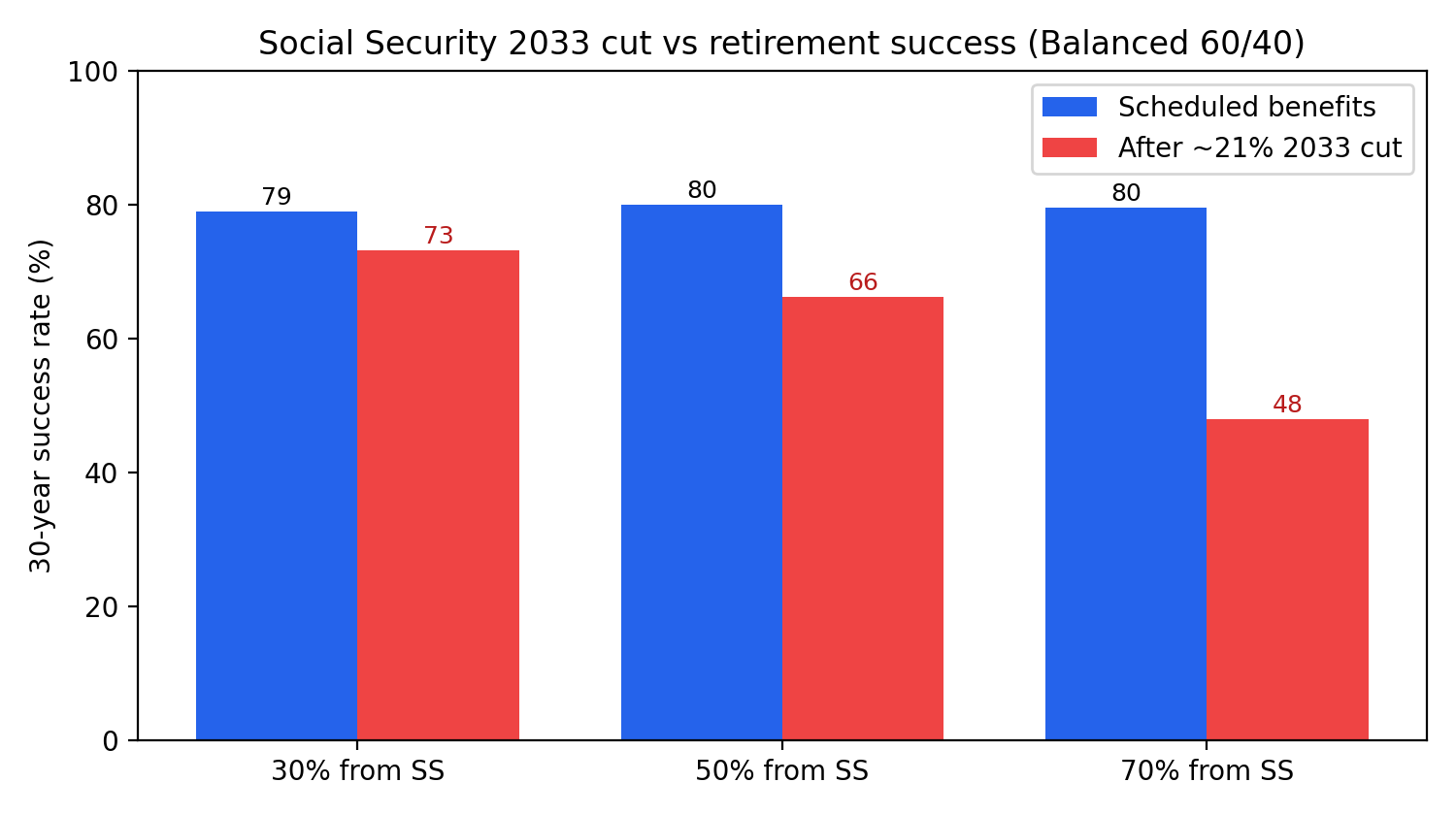
The more of your spending Social Security covers, the more a cut hurts. For the balanced 60/40 portfolio:
| Share of spending from SS | Success, scheduled | Success, after cut | Drop | Extra savings to offset |
|---|---|---|---|---|
| 30% | 78.9% | 72.4% | −6.5 pp | $68,513 |
| 50% | 80.0% | 64.7% | −15.3 pp | $122,768 |
| 70% | 79.5% | 44.3% | −35.2 pp | $173,235 |
Result 2: the savings needed to offset it
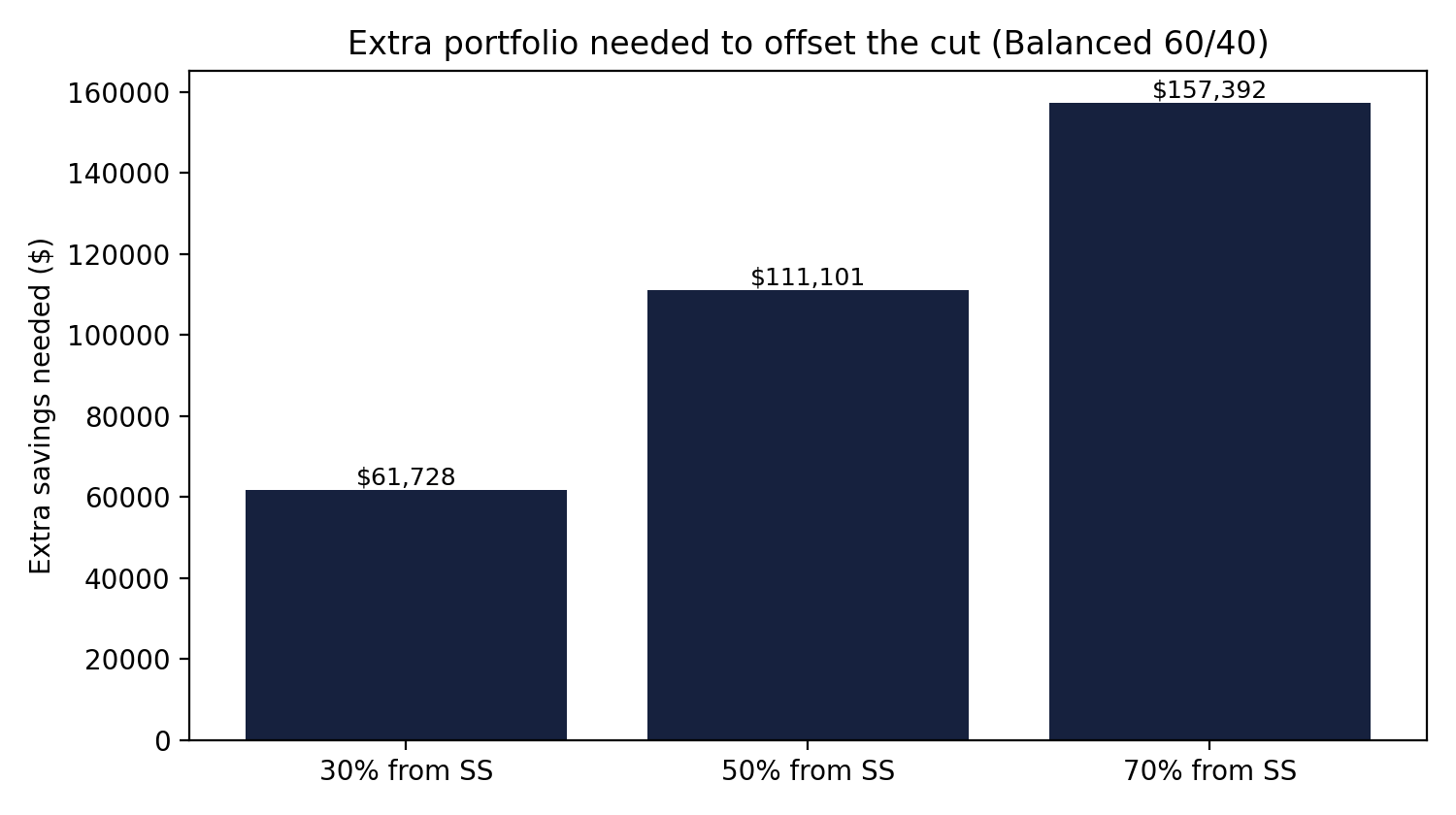
Restoring the pre-cut odds is a matter of more capital. A retiree more dependent on Social Security needs a larger buffer because a 22% cut removes more of their guaranteed income.
Every allocation and reliance level
| Allocation | SS share | Portfolio | Scheduled | After cut | Drop | Offset |
|---|---|---|---|---|---|---|
| Conservative (2% real, 6% vol) | 30% | $1,050,000 | 63.8% | 49.3% | −14.6 pp | $70,548 |
| Conservative (2% real, 6% vol) | 50% | $750,000 | 63.6% | 31.7% | −31.9 pp | $119,623 |
| Conservative (2% real, 6% vol) | 70% | $450,000 | 64.4% | 7.3% | −57.2 pp | $169,375 |
| Balanced 60/40 (4% real, 11% vol) | 30% | $1,050,000 | 78.9% | 72.4% | −6.5 pp | $68,513 |
| Balanced 60/40 (4% real, 11% vol) | 50% | $750,000 | 80.0% | 64.7% | −15.3 pp | $122,768 |
| Balanced 60/40 (4% real, 11% vol) | 70% | $450,000 | 79.5% | 44.3% | −35.2 pp | $173,235 |
| Equity-tilted (6% real, 16% vol) | 30% | $1,050,000 | 81.9% | 78.0% | −3.9 pp | $70,343 |
| Equity-tilted (6% real, 16% vol) | 50% | $750,000 | 82.3% | 72.4% | −9.9 pp | $133,966 |
| Equity-tilted (6% real, 16% vol) | 70% | $450,000 | 81.5% | 58.8% | −22.7 pp | $167,323 |
What it implies for retirees
- The cut is a portfolio problem, not just a benefits problem. Its real cost is the higher withdrawal it forces on your investments after 2033.
- Reliance is the risk factor. The more of your plan rests on Social Security, the more a cut matters — and the more an extra savings buffer is worth.
- You can size the buffer now. The offset column turns an abstract policy risk into a concrete savings target you can plan around.
Model the 2033 cut in your own plan
Free: enter your benefit in the Social Security 2033 cut calculator, or stress-test the cut inside a full 10,000-path Monte Carlo retirement plan — no signup.
Open the 2033 cut calculator →Methodology
Monte Carlo over normal real investment returns by allocation regime — conservative (2% real, 6% volatility), balanced 60/40 (4% real, 11%), and equity-tilted (6% real, 16%) — with 10,000 return paths per cell. Spending is withdrawn at the start of each year; the remainder grows by that year's real return. A path "fails" if the portfolio is exhausted before the 30-year horizon ends. Social Security is treated as real (inflation-indexed) income; in the cut scenario it falls to 78% of scheduled from 2033. Portfolios are sized to a 4% withdrawal on the initial income gap so that only the benefit cut differs between scenarios. The 22% figure and the Q4 2032 depletion projection follow the 2026 Social Security Trustees Report (ssa.gov/oact/trsum/, released 2026-06-09). Because the model steps in whole calendar years, this is a simplification of the Trustees' quarterly depletion estimate: the cut is applied starting with 2033, the first full year in the reduced-benefit regime, rather than pro-rated within 2032.
Reproducibility
The full per-cell results are published as open data under a CC0 public-domain dedication: results.csv and summary.json. The simulation is seeded (seed 20260701) and deterministic. Source: Social Security Board of Trustees, 2026 Annual Report (ssa.gov/oact/trsum/). See our methodology for the shared return-model assumptions used across QuantCalc research.
FAQ
What happens to a retirement plan if Social Security benefits are cut in 2033?
Its odds of lasting 30 years fall, and the fall scales with how much of the spending Social Security covers. In this 10,000-path Monte Carlo of a household retiring at 65 in 2026 on $60,000 of real spending, a 22% cut from 2033 (payable benefits at 78% of scheduled, per the 2026 Trustees Report, https://www.ssa.gov/oact/trsum/, checked 2026-09-10) lowers a balanced 60/40 retiree's success rate from 80.0% to 64.7% when half the spending comes from Social Security — a 15.3 percentage-point drop that about $122,768 more saved at retirement would offset. Across the grid the drop runs from 3.9 points (Equity-tilted (6% real, 16% vol), 30% of spending from Social Security) to 57.2 points (Conservative (2% real, 6% vol), 70%). Portfolios are sized to the 4% guideline on the initial income gap, and nothing is reduced today — see the full grid and the methodology.
Will Social Security really be cut in 2033?
Not automatically, and not today. The 2026 Social Security Trustees Report (https://www.ssa.gov/oact/trsum/, checked 2026-09-10) projects that the Old-Age and Survivors Insurance trust fund reserves will be depleted in Q4 2032, making 2033 the first full calendar year of reduced benefits. If that happens and Congress does not act, continuing payroll-tax revenue would cover roughly 78% of scheduled benefits — about a 22% across-the-board reduction. Congress has historically acted before such deadlines, but the shortfall is real and worth planning for.
How much does the cut lower retirement success?
In our Balanced 60/40 base case, a retiree drawing half their spending from Social Security sees their 30-year success rate fall from 80.0% to 64.7% — a 15.3 percentage-point drop — when the 22% cut takes effect in 2033, the first full reduced year following the Q4 2032 projected depletion. The more of your retirement income comes from Social Security, the larger the hit.
How much extra would I need to save to offset it?
For that same base case, restoring the original success rate took about $122,768 of additional starting portfolio in the simulation. The full table shows the figure for every allocation and reliance level.
Who is most exposed?
Retirees who rely on Social Security for a larger share of their spending, and those with more conservative portfolios that have less growth to absorb a higher withdrawal after 2033. Higher-income retirees with large portfolios are less affected in percentage terms because Social Security is a smaller part of their plan.
Can I model my own numbers?
Yes. The free Social Security 2033 cut calculator lets you enter your own benefit and time horizon, and the full Monte Carlo planner lets you stress-test the cut inside your complete retirement plan.
Published 2026-07-01, updated 2026-07-09 for the 2026 Trustees Report and 2026-09-07 with the answer-first summary (data unchanged), by QuantCalc Research. Educational research, not financial advice. Related: when to claim Social Security (Monte Carlo) · 2033 cut calculator · Social Security & IRMAA.